
Appointments & Questions
What if I wait to treat a nail? Ask your doctor
One block of paper per option, four lines to fill in, and the exact sentence that asks about waiting — so you leave with words instead of a guess.
Educational organizing help. Not medical advice.
The appointment you can already picture
You can see how it goes. The professional glances at your nail, says one word, writes a prescription, and you are back in the car before you have asked about side effects, how long you would be taking it, or what else exists. Or a laser is mentioned, you already know you cannot pay for it, and you leave without knowing what to ask about instead.
You are not being difficult. Visits move fast, and trade-offs are hard to discuss with your socks off. This page is an organizing method, not medical advice. It does not say what is wrong with your nail or which option suits you; those answers come from a qualified health professional. It gives you one block of paper per option, four lines to fill in, and one exact sentence to ask about waiting.

Browse 42 question prompts.
The free question prompt bank has 42 prompts in five groups to read and borrow wording from. Choosing your top three and printing them as one page happen in the visit pack builder, part of the free visit kit.
Free to browse. The question page comes with the free kit sign-up and a VERIFY reply.
One block per option your doctor names
Five lines and a name. Three options means three blocks, half a page each.
| Line | What to write down |
|---|---|
| Option, as named | The words the doctor used, in their order, not your version of them. |
| The routine it involves | What you would do or take, how often, and where — at home or at the office. |
| How long it lasts | A number in weeks or months. If the answer is a range, write the range. |
| What monitoring means | What gets checked, by whom, and when — plus what you are meant to notice between visits. |
| If I want to think or wait | The answer in the doctor’s words, and what would mean calling the office sooner. |
A place to record what you are told. This page does not rank options or say which one fits you.
1. Write the name first.
Copy the option exactly as it was said, before you react to it. Notes read better later when the words are the doctor’s.
2. Ask for the routine out loud.
“Would you say the routine out loud? I want to write it correctly.” Fill in what, how often, where, and who does each part.
3. Ask how long, in weeks or months.
A number you can plan around beats “a while” you cannot.
4. Ask the waiting sentence, then stop talking.
“What if I want to think about it or wait?” Write the answer before you reply to it, then ask what would mean calling sooner.
Option 1, as named: “a tablet, once a day” · Routine: one at breakfast, at home, refill at the pharmacy · How long: the number of weeks the doctor said, written the same day · Monitoring: what the office would check and when · If I want to think or wait: their answer, plus “call sooner if ___”
Fictional wording for illustration only. Not a patient case, a recommendation or a health result.
Duration of medication: ask in weeks, not “a while”
How long a medication runs shapes everything else — your calendar, pharmacy trips, refill budget. Ask it for every option and date the answer.
The American Academy of Dermatology’s page on nail fungus: diagnosis and treatment shows why a duration line earns its place. It describes one prescription topical, efinaconazole 10% solution, applied once a day at home, usually for 48 weeks, and says it must be applied for as long as prescribed, even if symptoms begin to go away. The same page notes that nails grow slowly, so treatment takes time. That is what it says about one medication, not a rule for every nail and not a plan for you.
The same page describes possible side effects of that topical as mild, most commonly an ingrown toenail and irritated skin around the nail, which may cause swelling or itching. Ask about side effects while the sheet is open, and write what your doctor says to do if something shows up.
“What if I want to think about it or wait?”
Say the sentence as written. A prepared line is easier than an improvised one when you are worried about sounding awkward: “What if I want to think about it or wait — what would you want me to watch for, and when should I come back?” Then stop talking and write three things: the answer in their words, any follow-up date they gave, and what would mean calling the office sooner.
If the answer is “do not wait,” write that down too, with the reason attached. Asking about waiting is not refusing care. It is how you find out what the trade-off is in your situation.

When one option costs more than you can spend
An option you cannot pay for is not really an option until you know what else exists. This page prices nothing, ranks nothing and says nothing about which option works. Keep three lines on the sheet:
- “If that is not possible for me, what would you suggest instead?” Write the answer under the option name.
- “Who should I ask about what this costs?” Write the office or number they give you, so the next call is not a search.
- “Does anything about the routine change if I start later?” Record their answer, not your guess.
What to watch for between visits
Ask the doctor to say in plain words what you should notice and what should prompt a call, then write those lines under the option with the date. A short dated record of what you see between visits is also useful to read from at the next appointment; our Care Instruction Capture Template has a page for instructions as given, your own understanding, and points still to clarify.
One cited point shows why the professional assessment matters more than a label. The AAD’s page on nail fungus: diagnosis and treatment notes that another nail condition, such as nail psoriasis or a nail injury, sometimes looks like nail fungus. That is one reason not to settle the question from a search result, and a good reason to ask what the doctor is looking at. For more wording, see questions to ask about nail treatment options.
Why would a free printable change anything?
A fair question, and it deserves a straight answer. If you have already spent money on creams, soaks and gadgets that promised a lot, your guard is up, and it should be. Nothing is sold on this site: no supplements, no devices, no accounts, no checkout. The free files are pages to write on, which is the same reason a shopping list works. They promise nothing about your nail.
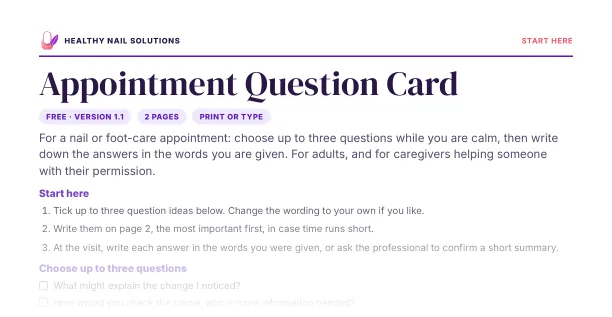
The Appointment Question Card is two pages: eight question ideas to tick, four preparation checks, and space for three questions with the answer, a clarify line and a follow-up. The waiting sentence and the duration questions on this page fit straight into it, and the card travels in the folder with your appointment paperwork. For a fuller set, the Nail and Foot-Care Visit Kit comes as one 24-page PDF in US Letter or A4, an editable DOCX you can type into offline, or one ZIP with all three.
About the email, since that is the part that makes people cautious. Downloads here ask for a first name and an email address, because that is how the file link reaches you, and the form asks for nothing else — no health details, no diagnosis, no medicine list. You get a short confirmation email with no link; reply VERIFY and the delivery email with the link follows. Replying also starts four short tip emails, about 2, 4, 7 and 11 days later, then at most one email a week, when we publish a new guide. Every email has an unsubscribe link at the bottom. If you would rather not give an email at all, the method still works: four lines on any sheet of paper and one prepared sentence.
Organization tools, not medical advice. This page helps you prepare questions and keep notes. It does not diagnose a nail condition, recommend a treatment or promise a result. For an assessment, speak with a qualified health professional. Educational and medical scope
Questions people ask
What if I wait to treat a nail?
Only the professional who examines your nail can tell you what waiting would mean for you. Ask the exact question — “what if I want to think about it or wait?” — and write the answer in their words, along with what would mean calling the office sooner.
How long does nail fungus medication take?
It depends on the medication and on your nail, and the answer belongs to the professional treating you. The American Academy of Dermatology page on nail fungus describes one prescription topical, efinaconazole 10% solution, applied once a day at home, usually for 48 weeks, and notes that nails grow slowly, so treatment takes time.
Can I stop when my nail starts to look better?
Ask before you stop, and write the stopping rule on the same sheet as the routine. The AAD page says that one prescription topical must be applied for as long as prescribed, even if symptoms begin to go away.
Sources and editorial notes
- American Academy of Dermatology, Nail fungus: diagnosis and treatment, retrieved October 18, 2026. It describes a prescription topical, efinaconazole 10% solution, applied once a day at home, usually for 48 weeks; notes that it must be applied for as long as prescribed even if symptoms begin to go away; lists possible side effects as mild, most commonly an ingrown toenail and irritated skin around the nail, which may cause swelling or itching; notes that nails grow slowly, so treatment takes time; and notes that another nail condition, such as nail psoriasis or a nail injury, sometimes looks like nail fungus.
Durations, side effects, monitoring and follow-up are decided by the professional treating you. This page states no treatment plan of its own; it only shows where to write down what you are told.
Examples are illustrative. Not clinically reviewed. See our Editorial Policy, Review Methodology and Affiliate Disclosure.
Keep your preparation connected
Back to the blogQuestions to Ask About Nail Treatment Options
Prompt list for options, side effects, and what to watch for.
How to Record Podiatrist Instructions at Your Visit
How often, how long, a missed dose and a clarify box, before you stand up.
Three Questions to Write Before a Nail-Care Appointment
Describe what you noticed, choose three questions, record the answers.
Write the four lines before the visit.
A dated record of what you were told beats a memory of a fast conversation.
Free · email to download.