
Free · email to download
Go in with three clear questions.
You have booked an appointment about a nail that has changed. This free card helps you bring three clear questions about the options, what they involve and what to watch for, with space to write down what you are told.
Free: enter your first name and email, reply VERIFY to our short email, and we email you the link. No account or purchase. 2 pages, Letter size. PDF about 290 KB, with fields you can type into on screen; DOCX about 5 KB.
It is late, you have already spent money on creams and soaks, and the appointment about a nail that has changed is finally booked. What you do not have yet is a plan for what to ask once you are in the room.
You may be braced for a visit that ends with a prescription and nothing else, or with a treatment you cannot picture affording, and no real chance to ask what the other options are. This card is for that conversation. It helps you choose your questions while you are calm and keep the answers together afterward. It does not tell you what is causing the change in your nail, and it does not suggest what to use.
Free question prompts
Browse 42 question prompts.
Five groups: understanding what was found; instructions and next steps; products and claims I have seen; practical and appointment details; and for caregivers. Read them here and borrow any wording. Ticking your choices, putting them in your own words, marking your top three and printing a question page happen in the visit pack builder, which comes with the free kit: enter your first name and email, reply VERIFY to our short email, and we email you the link.
Read the prompts that fit your visit. All 42 prompts, in 5 groups.
Understanding what was found
- What do you call what you are seeing, and how do you spell it?
- Could you explain what you found in plain words?
- What might explain the change I noticed?
- How would you check the cause, and is more information needed?
- What is still uncertain, and how will we find out more?
- Could you write down any names or terms you used, so I can find them later?
- What should I write down from today so I remember it correctly?
- Is there a printed sheet or summary of today's visit I can take home?
- Where can I find reliable information about what you described?
Instructions and next steps
- If you recommend a plan, how should I record your instructions?
- Could you repeat that instruction slowly, so I can write it in your words?
- Can I read my summary back to you to check that I understood it?
- Can I have these instructions in writing?
- If I can only remember one thing from today, what should it be?
- What should I do if an instruction seems unclear once I am home?
- Who should I contact if I have a question after today?
- What should I watch for, and when should I contact your office?
- When should follow-up happen?
- Is there anything I should bring next time?
Products and claims I have seen
- I saw a product that claims fast results for nails. How should I judge claims like that?
- When an ad shows before-and-after photos, what should I keep in mind?
- How can I tell whether a website about nail or foot care is a reliable source?
- I have read different advice in different places. Who should I ask when sources disagree?
- If I read about something new, how should I bring it up with you?
- Would it help if I brought the label of any product I already use?
- Where can I find reliable information about your recommendations?
Practical and appointment details
- How long is the appointment, and should I arrive early?
- Which forms or records should I bring?
- Is there anything I should wear or bring to make the visit easier?
- Is it all right if I take notes during the visit?
- Can someone come with me to help take notes?
- How do I confirm, change or cancel my next appointment?
- What is the best way to reach the office with a question?
- How do I find visit notes or messages from the office later?
- Who can I ask about costs or insurance before the visit?
For caregivers
- What permission or form does your office need before you can share information with me?
- With the person's permission, may I take notes during the visit?
- Could you speak to the person directly, while I write down the answers?
- Could you say the instruction the way you would like me to pass it on to other helpers?
- Who should other helpers contact if they have a question?
- What should I record so the next helper knows what was agreed today?
- If the person and I remember something differently, who should we ask?
Choosing, editing and printing your question page happen in the visit pack builder. Part of the free visit kit: enter your first name and email, reply VERIFY to our short email, and we email you the link.
The prompts ask a professional to explain. They do not suggest what you have or what to use.
Printable + editable
A PDF to print and write on, or to type into on screen, and a DOCX if you want to change the wording.
Use it on its own
No other resource or purchase is needed. One card covers one visit.
Only your name and email
The download asks for your first name and email so we can send you the file link, and nothing more. Every email has an unsubscribe link at the bottom.
A look at what is on the card
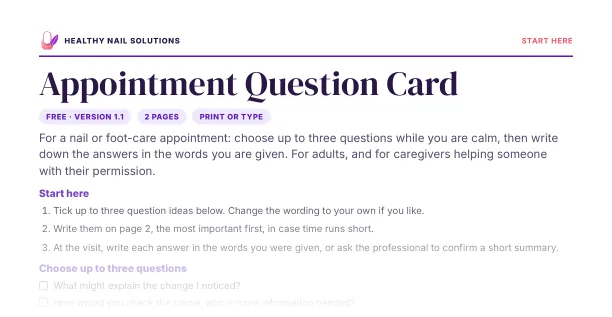
Page 1 of the card lists eight question ideas and four ways to prepare. You tick up to three questions, then write them in your own words on page 2. A qualified professional supplies the answers.
Three of the eight question ideas
- What might explain the change I noticed?
- What options, uncertainties or tradeoffs should we discuss?
- What should I watch for, and when should I contact your office?
The rest is in the free card
The other five question ideas, the four preparation steps and the page for writing down what you are told come in the card itself: enter your first name and email, reply VERIFY to our short email, and we email you the PDF and DOCX.
You do not need to know the cause of a change before you ask about it.
If you are not sure which three to pick, start with the one you would most regret leaving without asking. Two ideas are easy to skip and worth keeping: what the options and tradeoffs are, and what to watch for afterward.
If a treatment comes up in the conversation, the card gives you room to ask what it involves, what it costs, what the tradeoffs are, and what happens if you want time to think it over before deciding. Asking about side effects, or about what you should watch for, is not a challenge to the professional. It is how you decide together instead of guessing.
If you have already tried creams, soaks or other things, say so. It is your own history, and you can ask how the options discussed compare with what you have already tried rather than leaving that part out.
How to use your card
Save or print a private copy.
Print the PDF and write by hand, or type into the PDF or the DOCX and then print. Keep the file with your other appointment paperwork.
Choose your three questions.
Tick up to three ideas on page 1, then write your own wording on page 2. Three is enough to carry in; anything else can wait for the next visit.
Record the answers, or ask for a summary.
At the appointment, write down each answer, or ask the professional to confirm a short summary. If you are not sure you caught something, read your notes back and ask.
Keep the card with your own paperwork.
Add the follow-up date and contact details from your paperwork, and store the card where you will find it for the next step.
“I noticed a change last month. My three questions are what might explain it, how it would be checked, and when I should follow up.”
Record keeping only. Not a patient case or a health result.
If the visit turns out shorter than you hoped, ask which of your three questions the professional would answer first, and write the other two on the card with a date to ask next time. A question you already wrote down survives a rushed room better than one you meant to ask.
A small card, a useful record
Page 2, “My three appointment questions,” has a field for each part of the conversation:
- Appointment date and my main priority
- Questions 1, 2 and 3, each with space for the answer in the words you were given
- What I want clarified, and the follow-up, beside each question
- Terms to spell, written down by the professional
- Follow-up date and contact details from my own paperwork
It ends with three quick checks:
- I can find my questions.
- I recorded what I understood.
- I asked about anything unclear.
The card is not a test you can fail. It is a place to keep what you asked and what you were told, so the next appointment can start where this one ended.
Download the card
Two pages, US Letter size. Print the PDF at actual size (100%), type into its fields on screen, or save the DOCX and edit it in Word, LibreOffice or Google Docs. The download asks for your first name and email so we can send the link; nothing you write in the file comes back to us. How we checked the card and the prompt bank: resource test record.
File Access Help
Your questions. Your copy.
Keep completed notes private. Do not send photos or completed health records through any form on this site. Caregivers should have permission before recording or sharing another person’s information, and should write that person’s questions in their own words where they can.
This card organizes a conversation. It gives no diagnosis and no treatment instructions, and it cannot tell you what is causing a change in a nail. What it can do is make sure the questions you already have are written down, in your own words, ready to ask. The American Academy of Dermatology notes that another nail condition, such as nail psoriasis or a nail injury, sometimes looks like nail fungus, which is one reason a professional assessment matters.
Helpful questions
Do I need the visit kit too?
No. The card works on its own. The free visit kit is optional if you also want a nail map, a photo log and pages for the follow-up.
What if an instruction is unclear?
Ask the professional or the office to confirm it. Leave uncertain details blank rather than guessing.
Can I edit the card in Google Docs?
Yes. Upload a copy of the DOCX and choose Open with Google Docs, then check the layout before printing. File Access Help has more tips.
Is anything I write sent to you?
No. The card is a file you keep. Nothing you write in it reaches us.
Need a little more room?
If three questions feel tight, or you want somewhere to keep a week of notes or a longer record of what you were told, these are the next steps.
Three Questions to Write Before a Nail-Care Appointment
Describe what you noticed, choose three questions, record the answers.
Free Nail and Foot-Care Visit Kit
24 pages: nail map, questions by visit type, photo log, visit record and follow-up.
Care Instruction Capture Template
Separate received wording from what you want clarified. Free with your email.
Organization tools, not medical advice. This page helps you prepare questions and keep notes. It does not diagnose a nail condition, recommend a treatment or promise a result. For an assessment, speak with a qualified health professional. Educational and medical scope
Sources and editorial notes
- American Academy of Dermatology, Nail fungus: diagnosis and treatment, retrieved October 18, 2026.
- MedlinePlus (U.S. National Library of Medicine), Talking With Your Doctor, retrieved October 18, 2026. It suggests making a list of the questions you want to talk about and taking notes during the visit.
Examples are illustrative. Not clinically reviewed. See our Editorial Policy, Review Methodology and Affiliate Disclosure.
Want somewhere to keep the answers afterward?
The free visit kit adds a nail map, a photo log, a visit snapshot and pages for the follow-up.
Free: enter your first name and email, reply VERIFY to our short email, and we email you the link. Then 4 short tip emails over 11 days, each with an unsubscribe link. Nothing is for sale.