
Appointments & Questions
Three questions to write before a nail-care appointment
The visit is short and your nerve may not hold. Three questions on one small card, the worrying one first, is a plan you can make at the kitchen table tonight.
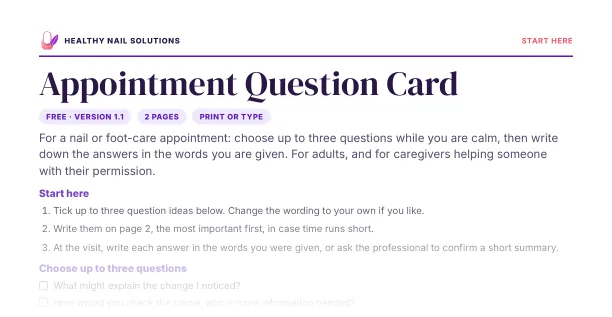
The thought that makes your stomach drop
It is late and you are on your phone again, reading about toenail fungus. Thickened. Yellowish. Lifting at one edge. You look at your own right big toenail, then back at the screen.
It has been about a year. You have tried the vinegar soaks, the tea tree oil, two drugstore creams and something bought from an ad at one in the morning. You have stopped wearing sandals in July.
The appointment is booked, which is the brave part. What is left is the picture you cannot stop making: the podiatrist glances at the nail, says “fungus,” writes something and stands up — and the small change near the cuticle that worries you more than the color stays in your mouth while the door closes.
You cannot control how long the visit lasts or what the assessment finds. You can control what is written down before you walk in: three questions on one small card, the worrying one first.
This page is an organizing method, not medical advice. It does not tell you what is wrong with your nail or what to do about it. The American Academy of Dermatology notes that an injury or another nail condition can look like nail fungus, so a qualified health professional assesses a nail.
Not sure who to book? Who looks at nails and feet sums up what public health sources say. For the visit itself, see what a nail or foot visit may involve.

Browse 42 question prompts.
The free question prompt bank has 42 prompts in five groups to read and borrow wording from. Choosing your top three and printing them as one page happen in the visit pack builder, part of the free visit kit.
Free to browse. The question page comes with the free kit sign-up and a VERIFY reply.
Start with what you noticed
Your first job is not a diagnosis. It is one short note you can read out if your voice goes wobbly.
- Which nail, and which foot.
- Roughly when you first noticed it — a month, a season, “around the time I moved.”
- What has changed since, in your own words: color, thickness, shape, the edge, the skin near the cuticle.
- Anything that came just before: a knock, a stub, tight shoes.
- What you have tried, for how long, and what you noticed.
- Anything that makes walking or wearing shoes uncomfortable.
Two rules keep this useful: plain words rather than terms you looked up, and no guessing at a cause. A blank line is honest; a guess can send the conversation the wrong way.
Write your three questions
Three is a workable number. It covers what matters most, fits a short appointment, and stops you shuffling through a long list while the clock runs. Put the one that keeps you up at night at the top.
1. The worry first.
“There is a change near my cuticle that worries me more than the color. What could cause that?” Ask what could cause it rather than proposing a verdict. If a term comes up that you do not know, that becomes a second question: “Could you write that down so I can look it up later?”
2. How it would be checked.
“How would you check what this is?” asks for a process instead of a glance. The AAD page on nail fungus diagnosis and treatment describes procedures that dermatologists perform during an office visit, and it warns against scraping white discoloration from a nail at home, because that is a medical procedure needing the right tools and experience.
3. What happens next.
“What should I do next, and when should I contact your office?” A follow-up line gives the visit somewhere to land, and gives you something to write in the space under it.
Other lines worth having: “I have used a lot of things I bought myself. Would it help to go through them?” and “Could you write down any instructions, so I have them in your words?” The free question prompt bank has 42 more to pick and edit.
Star your main question. If time runs short, that is the one you ask first.
What I noticed: right big toenail, thicker and yellowish since last spring; a small change near the cuticle that I keep looking at.
1. What could cause the change near my cuticle? (ask first)
2. How would you check what this is?
3. What next, and when should I call?
Fictional wording to show the layout. Not a patient case, a symptom guide or a health result.
What to say when you sit down
The first ten seconds are the part you can script. Choose one opening sentence at home and write it at the top of the card in larger letters.
- “I wrote three questions down because I get flustered. May I start with the main one?”
- “The color bothers me less than the change near the cuticle. Could you look at that first?”
- “I would like to note your answers as we go. Is that all right?”
Then hand the card over if the words will not come. Paper does not get nervous, and a written question is harder to skip than a spoken one.

Keep the answer with the question
Write short phrases under each question while the answer is given, in their words rather than yours. Then read it back: “So the plan is what you just described — did I get that right?”
Afterward, add a line labeled “my understanding,” kept apart from the words you were given, so later you can tell which is which. Anything unclear becomes a point to clarify, and you can ask the office to confirm it or send it in writing.
Before you leave, fill in the last line: what happens next, and when to contact the office. That is the line most people forget, and the one that decides whether the visit still feels useful six weeks later.
If you are writing for someone else, ask their permission before you record, carry or share anything about them. The waiting-room version of this method is in using your question card when there is no desk.
The free card, and why we ask for an email
You have spent money on things that promised a lot, so your guard is up, and it should be. Here is the plain version.
The Appointment Question Card is paper. Two pages, Letter size, a printable PDF and an editable DOCX that works offline. Page 1 has eight question ideas to tick, four preparation checks, short instructions and a fictional example. Page 2, “My three appointment questions,” gives each question a space for the answer, a point to clarify and a follow-up. It treats nothing. It is not a treatment plan, and nothing in it promises a result.
About the email: downloads here ask for a first name and an email address because that is how the file link reaches you. We send a short email first; reply VERIFY to it and the delivery email with the link follows as soon as your reply arrives. Signing up also starts four short tip emails, sent about 2, 4, 7 and 11 days after you reply VERIFY, and then the series ends. Every email has an unsubscribe link at the bottom.
We do not ask for health details and we ask you not to send any. The files are static, so nothing you write on the card reaches us. There is no account, no checkout, and nothing for sale on this site. If you would rather not give an email address, an index card does the same job: three questions, space under each, both sides. The free Nail and Foot-Care Visit Kit adds a visit snapshot page and 58 questions sorted by type of visit if you want more.
Organization tools, not medical advice. This page helps you prepare questions and keep notes. It does not diagnose a nail condition, recommend a treatment or promise a result. For an assessment, speak with a qualified health professional. Educational and medical scope
Before you go
- One short note on what you noticed, in plain words, with an approximate date.
- Three questions, the worrying one first and starred.
- A space under each question for the answer.
- Your opening sentence at the top in larger letters.
- The card in a folder with your paperwork, not folded in a pocket.
- One line left empty for: what next, and when to call.
Comparing where to keep all of this? Our guide to notebooks for appointment questions explains what to check and names no products. A notebook you already own is a fine answer.
Questions people ask
What do I say if I am not sure it is toenail fungus?
Say what you noticed and roughly when, in your own words, then ask your main question first: for example, could the change near my cuticle be something other than fungus? You do not have to name a condition to have a nail looked at. The American Academy of Dermatology notes that an injury or another nail condition can look like nail fungus.
Will they take me seriously if I read from a card?
No one can promise how a particular professional will respond. What a card does is make your question hard to lose: it is in your hand, in order, with the worrying one at the top. Saying “I wrote this down so I would not forget” takes care of the awkwardness of reading from paper.
Why would a free printable help when creams and soaks did not?
It does not treat anything and it promises no result. It changes what happens in the room: your main question is written at the top, the answer has a space under it, and you leave with the next step in your own handwriting.
What happens to my email address?
It is how the download link reaches you: we send a short email first, and once you reply VERIFY, the delivery email follows. Signing up also starts four short tip emails, sent about 2, 4, 7 and 11 days after you reply VERIFY, and then the series ends; every email has an unsubscribe link at the bottom. We do not ask for health details. Nothing is sold on this site and there is no account.
Sources and editorial notes
- American Academy of Dermatology, Nail fungus: diagnosis and treatment, retrieved October 18, 2026. It describes procedures performed during an office visit, warns against scraping a nail at home, and notes that no laser has FDA approval to treat nail fungus.
Examples are illustrative. Not clinically reviewed. See our Editorial Policy, Review Methodology and Affiliate Disclosure.
Need somewhere to keep the card?
Your current notebook may be enough. If you are comparing options, look for room for questions and answers.
No products are named or ranked.
Keep your preparation together
Back to the blogHow to Use Your Question Card When There Is No Desk
Plan a writing surface and keep pages together.
What to Bring to a Nail or Foot-Care Appointment
Ask the office, gather your card and notes, return papers to one place.
How to Record Podiatrist Instructions at Your Visit
How often, how long, a missed dose and a clarify box, before you stand up.
Ready to write your questions?
Browse 42 free question prompts, then write your top three in your own words, most important first.
Free to browse. Making and printing your question page comes with the free kit sign-up.