
Notes & Follow-up
How to record podiatrist instructions before you leave the room
Twice a day for two weeks, or four? If the plan lives only in your memory of a rushed room, the drive home is where it goes soft. This one-page method copies the podiatrist’s exact words while you are still there, next to a box for what you still need to clarify.
The plan was said out loud in the room. Twice a day, you were told. For two weeks — or was it four? By the time you reach the car the detail has gone soft, the prescription is in the bag, and nothing is written down. In week three the safest-seeming move is to stop, not because anyone said to, but because you cannot recall the rule you were given.
If you have already spent a year on soaks, oils, creams and a gadget that promised a lot, that lost sentence is the part that hurts most. It is also the part you can fix. This page is about one job: recording a podiatrist’s instructions accurately before you leave the room, on one page, in the words you were actually given.
The short version. Four facts written before you stand up: how often, how long, what to do if you miss a dose, and when to come back. The exact wording on one line, your own understanding on another. A clarify box for anything half-heard. One page filed the same day.
Get the free capture template See the method
Other pages cover the steps around this one: three questions to write before the visit, a numbered after-visit sheet for home and making sense of a printed handout.

Four facts to write before you leave the room
These four cover most of what goes missing by week two.
- How often. Twice a day, once a day, every other day: the words you were given, not a version of them.
- For how long. “Two weeks” and “four weeks” sound almost the same in a small room. Write the number in figures as well as words.
- What to do if I miss a dose. The easiest line to lose, and the one you will want in week three.
- When to come back, and what would mean calling sooner. A date, and a short “call if” line beside it.
Write them while the podiatrist is still in the room, even in the margin of a handout. If your hands are full, say the plain sentence out loud: “Could you write that down for me?” Asking does not make you a difficult patient.
Ask too whether the office can print a summary for you to take away. The American Academy of Dermatology’s page on nail fungus: diagnosis and treatment (checked October 23, 2026) notes that if a procedure is part of the plan, the dermatologist will give you instructions for at-home care. Instructions like that are easier to follow on paper in your own folder than from memory in a hallway.
Questions that pin the instructions down
Write these on the page before you go in, with room for the answer next to each one. You are not working out the answer yourself; you are making sure the timing and the method leave the room with you.
- “What do you want me to do, exactly, and how often?”
- “For how long, and when should I stop?”
- “What should I do if I miss a dose?”
- “What should I watch for, and when should I call your office?”
- “When do you want to see me again?”
Add one line at the top: “I want to write your instructions down exactly. Can I read them back before we finish?” It takes five seconds, and it changes the shape of the end of the visit. These are organization prompts, not a diagnosis in question form. The free Appointment Question Card has eight tick-box questions with room for answers, and the 42-prompt question bank is free to read.
What to write down during the visit
Most lost instructions are lost in translation. You hear something, you sum it up in your head, and the summary is what stays. Keep the two apart, and the page is still trustworthy six months later.
Copy the wording, not your summary.
Start with the date and who said it, then write what you were given, as close to word for word as you can. If you were handed a printed sheet, write “printed sheet, March 4” and keep the sheet with the page. If nothing was written down, it is fair to ask for the instructions in writing.
Put your own understanding on its own line.
Label it “My understanding” and write what you think it means. Your summary then cannot be mistaken for the original wording, by you later or by someone helping you.
Open the clarify box before you stand up.
Not a mental note. A box on the page, with the question written in it. This is the line that would have changed the drive home.
Do not write a guess about the cause of a nail change as if it were a fact. The American Academy of Dermatology notes that a nail injury or another nail condition, such as nail psoriasis, sometimes looks like nail fungus, which is one reason a professional assessment matters.
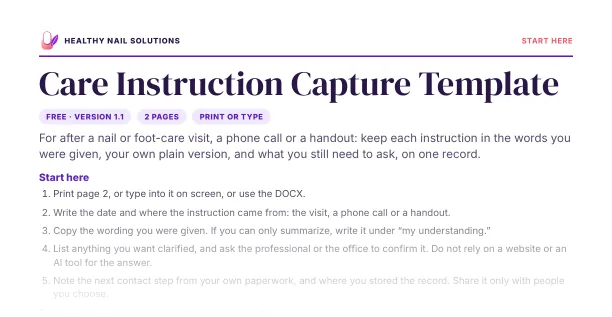
The free Care Instruction Capture Template is built around these three moves. It has six fields on one page: date and source, instruction as given, my understanding, point to clarify, clarification action, and where the record is stored. Page 2 is a blank instruction record for the next visit.
Record instructions in separate columns.
The free Care Instruction Capture Template keeps the instruction as given, your own understanding and the point to clarify apart. Printable PDF and editable DOCX.
Free: enter your first name and email, reply VERIFY to our short email, and we email you the link.
Add the line for a missed dose
This is the piece that changes week three. Somewhere on the record, write a short label: If I miss a dose. Underneath it, write what the office told you, in their words rather than your own, with the date and who said it.
If the line is still empty when you stand up, that is not a gap in your notes. It is your next question. Ask at the front desk, or write it in the clarify box and call the number on your handout. What to do about a missed dose is a clinical question, and nobody here can answer it for you.
The missed-dose line is a record, not advice. Write down what your own clinician or pharmacist said, and ask them when the space is empty.
A worked example
The entry below is invented to show the shape of the record. It is administrative only: no patient, no care instruction, no result.
| Date and source | End of the visit, said by the podiatrist, March 4 |
|---|---|
| Instruction as given | “Start with what we talked about, and we’ll look at it again in a few months.” |
| My understanding | I start the plan we discussed, and there is a follow-up visit later in the year. |
| If I miss a dose | Not given. Moved to the point to clarify. |
| Point to clarify | I did not catch the timing: how often, and for how long. I also do not have a date for the next visit, or an answer about a missed dose. |
| Clarification action | Call the office using the number on my appointment card, then write the answer here with the date of the call. |
| Where stored | Blue appointment folder, front pocket. |
Record keeping only. Not a patient case or a health result.
Fill in the clarify box
The clarify line is the easiest one to skip, and it is the line that would have changed that drive home. Writing in it is not an admission that you were not listening. It is a note that one detail still needs a name.
- Read it off the page. “I wrote this down so I wouldn’t forget. Can I read it back to you?” That sentence does the work when your mind has gone blank.
- Say it back and ask for a correction. “So what I have is… have I got that right?” Write down whatever gets corrected.
- Ask for it again. “Could you say the timing once more? I want to write it exactly.”
- Ask for it in writing. If there is a printed sheet or a handout, ask for a copy and keep it with the page.
Cross a line out only when the answer is written on the page with the date. If the answer comes later by phone, add the date you called and who you spoke with. A worksheet or an app should never decide what an unclear instruction means; the office that gave it should.

Keep every line short, dated and readable
Neat handwriting is not the goal. The page only has to answer three questions in week three: how often, how long, and what to do if you miss a dose.
- Date every entry the same way. “Tue, Nov 4” every time, so the pages sort themselves later.
- One fact per line, with numbers printed out: doses, dates and phone numbers.
- Leave space. Skip a line so a clarification can be added, and keep the edge near the binder holes clear.
- Test two pens on a spare sheet of the same paper. Note which one does not show through or smudge, then use that pen through the whole record. The planner pen guide compares pen types and names no products.
If handwriting is difficult or painful, type into the DOCX copy of the template and print that.
File the page the same day
- Date the top of the page and put it in the folder or envelope you take to appointments.
- Keep any printed sheet and the appointment card with it, so the wording and its source stay together.
- Put the next step in your calendar: the date to call, the date to book.
- Write where the page lives on the page itself — “front pocket of the blue folder.”
When several visits pile up, one index page at the front saves a lot of shuffling. Our article on filing twelve weeks of nail-care notes shows a simple version you can copy.
Why a free printable, after the creams and the soaks
It is a fair question. You have already spent money on soaks, creams and a gadget that promised a lot, and a free PDF from a website you have never heard of can sound like the start of another pitch. So here is the plain version.
This worksheet does not treat a nail, and it does not tell you what is wrong with yours. It holds what a qualified professional tells you, in your handwriting, in the order you will need it later. That is all it does — and it is exactly what was missing on the drive home.
The American Academy of Dermatology notes that the FDA has not approved any laser to treat nail fungus. Staying careful with anything that promises a lot, including free things, is reasonable.
- What it asks for: a first name and an email address, both required. No symptoms, no photos, no diagnoses, no medicine list, no account.
- What arrives: a short email asking you to reply VERIFY, then the delivery email with your download link as soon as your reply arrives, then four short tip emails over about eleven days, and then the series ends. Nothing is for sale, and every email has an unsubscribe link at the bottom.
- What you get: a printable PDF and an editable DOCX, Letter size. Both work offline, and nothing you write in them reaches us.
- What it is not: not medical advice, and not clinically reviewed. For your own nail or foot, ask a qualified health professional.
Nothing on this site is for sale today, and this page has no affiliate links. Our buying guides end with Amazon search links; as an Amazon Associate we earn from qualifying purchases. No paid product exists: an earlier paid toolkit proposal was withdrawn, and the toolkit page has the current status. The free template is the whole offer.
Use what you already have
None of this needs a purchase. A sheet of paper and a pen will do. Draw three columns — what was said, what I understood, what still needs clarifying — and use a fresh sheet for each visit. A folder you already own will hold a year of appointments. If the stack outgrows it, our guide to binders for nail-care records compares page fit and capacity; it names no products, and it may tell you that what you have is fine.
If you want a follow-up tracker and notes between visits to go with the instruction record, the free Nail and Foot-Care Visit Kit has them. If you are writing things down for someone else, ask their permission first, and keep their pages with their own paperwork.
Common questions
What should I write down during a podiatrist appointment?
The date, who said it, and the wording you were given, as close to word for word as you can: how often, for how long, what to do if you miss a dose, and when to come back. Then add a line labeled “My understanding” and a box for anything still unclear. Keeping those apart means your summary never gets mistaken for the original wording.
What if I forget the instructions on the drive home?
Fill in the record while you are still in the room, read it back once before you stand up, and file the page the same day. If something is still missing later, call the office using the number on your appointment card and write the answer on the same page with the date.
What if I forget a dose?
Write down what your clinician or pharmacist told you, in their words, with the date and who said it. If you never asked, write the question in the point-to-clarify column and call the number on your handout. What to do about a missed dose is a clinical question that only your own office can answer.
Does my handwriting have to be neat?
No. The page only has to answer three questions in week three: how often, how long, and what to do if you miss a dose. Short dated lines and one fact per line matter more than neat writing.
Do I have to give health details to get the free template?
No. The form asks for a first name and an email address. It does not ask for symptoms, photos, diagnoses or a medicine list, and there is no account to create. Every email has an unsubscribe link at the bottom.
Sources and editorial notes
- American Academy of Dermatology, Nail fungus: diagnosis and treatment, retrieved October 18, 2026 and checked again October 23, 2026 (at-home care instructions after a procedure; other nail conditions that can look like nail fungus; no laser approved by the FDA to treat the infection).
The four facts and the missed-dose line are a paperwork suggestion, not a care schedule or dosing advice. Examples are illustrative. This page is educational organization help, not medical advice about your nail or foot. Not clinically reviewed. October 23, 2026: this article now also holds the method from our former article on writing down appointment instructions, which redirects here. See our Editorial Policy, Review Methodology and Affiliate Disclosure.
Organization tools, not medical advice. This page helps you prepare questions and keep notes. It does not diagnose a nail condition, recommend a treatment or promise a result. For an assessment, speak with a qualified health professional. Educational and medical scope
Keep your notes connected
How to Remember Doctor Instructions After a Visit
Put each step in order and note who to call when unclear.
How to File Twelve Weeks of Nail-Care Notes
Date weekly pages, group them and keep an index.
How to Use Your Question Card When There Is No Desk
Plan a writing surface and keep pages together.
One page, filled in before you stand up.
The free Care Instruction Capture Template holds the date, the exact wording, your own understanding and the question you still need to ask.
Free · email to download