
Notes & follow-up
How to understand doctor handout instructions
Three plain columns turn the page you were handed into next steps you can read and questions you can ask.
A note-keeping method, not medical advice. Free · email to download.
You leave the appointment with a prescription and a printed handout. The page ends up in a drawer under the takeout menus. The print is tiny, the words are medical, and you cannot tell which lines apply to your nail and which are general information written for everyone. So it stays in the drawer, and nothing changes.
If the visit felt rushed, the questions you meant to ask may have arrived in the parking lot instead of in the room. That is not a personal failing. It is what a short visit and a folded handout do to anyone.
There is a fix that does not need another appointment. Take one sheet of paper, draw three columns, and fill them in while the visit is still fresh: the handout’s own words, your plain-language version of them, and the question you will ask to check you have it right. That is the whole method. It is a note-keeping method for adults and caregivers, not medical advice.
Record instructions in separate columns.
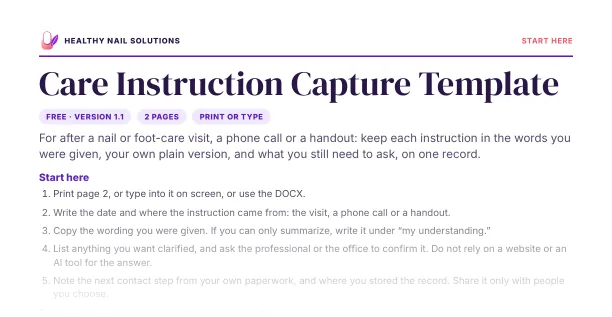
The free Care Instruction Capture Template keeps the instruction as given, your own understanding and the point to clarify apart. Printable PDF and editable DOCX.
Free: enter your first name and email, reply VERIFY to our short email, and we email you the link.

Why the handout ends up in a drawer
A handout has to be safe for thousands of different feet, so it stays general. That is why it can feel dense and vague at the same time. The pointing, the tone of voice and the “this bit matters” are gone by the time you sit down with a cup of tea, and the short forms that save the writer time can cost the reader the meaning.
MedlinePlus, from the U.S. National Library of Medicine, suggests listing the questions you want to talk about, taking notes during the appointment, and asking for written instructions if you need them. Each of those assumes the same small thing: someone writes the answer where it can be found again.
The American Academy of Dermatology notes that injury or another nail condition can look like nail fungus, which is one reason a professional assessment matters. That is also why column two below is never a conclusion. It is a reading you check with the person who looked at your nail.
Set up three columns
A plain sheet with three headings works. So does the free Care Instruction Capture Template, which has a similar record already ruled out, plus a second page for your own notes.
| What the handout says | What I think it means | Question to ask |
|---|---|---|
| the line, copied exactly | your everyday words, marked as your reading | who you will ask, and what you will ask |
A layout to copy by hand. Nothing you write on your own page reaches us.
- Column 1, the words you were given. Copy the line exactly: same spelling, same short forms, even the ones you do not recognize. Add the date and who gave you the page, so a line never floats free of its source.
- Column 2, your version. Say it the way you would say it on the phone, then write “my reading” beside it. A guess you have labeled is useful. A guess you have forgotten is not.
- Column 3, one question per gap. Every line you could not put into words becomes one short question. Short questions are easier to ask out loud, easier to answer, and easier to write down while the person is still in the room.
A fictional example: one jargon line, rewritten
These lines are made up to show the method. They are not a patient case, a health result or advice about anyone’s nail.
| What the handout says | What I think it means | Question to ask |
|---|---|---|
| “F/U 12 wks. Call if worse.” | “Come back in 12 weeks. Phone the office if the nail gets worse.” My reading. | On the next call: which parts of this page apply to my nail, and what would count as worse, in your words? |
| “Continue as directed.” | “Keep doing what we agreed at this visit.” My reading. | Ask them to write that direction on the page, so I am not relying on my memory of the room. |
Record keeping only. Not a patient case, not a health result and not medical advice.
Your plain version does not decide anything. It gives you a sentence to check. If it is wrong, the answer corrects it, and the correction sits in the same row, dated, in the words of the person who gave it.
Fill it in the same day
Ten minutes at the kitchen table beats an hour three weeks later. Do it before the handout goes into a folder, while you can still hear the conversation.
Head the page.
Date, the office, and the name of the person who gave you the handout. One line is enough.
Skim for lines that change something.
A date, a next step, something to stop, something to bring. Skip the general paragraphs.
Copy three to six lines.
Write your version of each and label it as your reading. Leave the ones you cannot put into words; the question column carries them.
Name who you will ask.
The office, the pharmacy counter, the nurse line. A question with a name attached gets asked.
When the print is too small
Tiny type is a printing problem before it is a reading problem. If the office can email the file, read it on a screen and zoom in. If you print it yourself, Microsoft’s help page for printing in Edge explains the scale options: “Fit to printable area” adjusts the content to fit the paper, “Actual size” prints it as it was made, and the preview shows the result before you use paper. If you only have the paper copy, ask the office for a larger print, or copy the lines you need in your own hand at a size you can read.

Questions to ask about the handout
Three or four questions is enough for one call, and enough to carry into a visit that may be short.
- Which parts of this handout apply to my nail, and which are general information?
- What should I watch for between now and the next visit?
- When should I call the office instead of waiting?
- Could you say the answer again while I write it down?
If the answer is “bring that to the visit,” write it down anyway. It tells you what the next visit is for. The free Appointment Question Card has more question ideas to tick, and choosing three questions before a nail-care appointment shows how to pick the ones that matter most to you.
“I have already spent money on creams and soaks”
Fair. You have bought things that promised to end the problem and did not, and you have good reason to be wary of a free printable that arrives with an email box attached.
So here is the honest version. A page cannot treat a nail condition, cannot make any product work, and does not promise an outcome. What it can do is hold the words of the person who looked at your nail where you can find them, so your next decision rests on that instead of on a label.
| What you type in | A first name and an email address. That is all the form asks for. |
|---|---|
| What the email is for | The download link, sent once you reply VERIFY to our short email. Then four short planning tips arrive about days 2, 4, 7 and 11, and then the series ends. Nothing is for sale, and every email has an unsubscribe link at the bottom. |
| No purchase, no account | The templates are free. Nothing on this site is for sale, and there is nothing to log in to. |
| No health details | We do not ask for symptoms, photos, diagnoses or medicine lists, and we ask people not to send them. |
| The files | A printable PDF and an editable DOCX, Letter size. Both work offline once downloaded. |
The same terms apply to every free download on this site.
File the handout with your page
Keep three things together: the original handout, your three-column page, and any answers you add later. Put your own page on top so you see your words first. If you were not given a handout, the same method works with the lines you jotted down; there is a short guide to writing appointment notes when there is no desk.
When the file starts to grow, a dated order and a one-page index keep it usable. Our guide to keeping appointment instructions organized shows how to group questions, instructions and weeks.
Helping someone else? Ask their permission before you write down or share their information, and keep their pages with their own paperwork.
A quick check before the next call
- The handout has a date and the name of the person who gave it.
- Three to six lines are copied exactly, not retyped from memory.
- Every plain version is labeled as my reading.
- Every open question names who I will ask.
- The handout and my page are stored together.
Sources and editorial notes
- MedlinePlus (U.S. National Library of Medicine), Talking With Your Doctor, retrieved October 18, 2026.
- American Academy of Dermatology, Nail fungus: diagnosis and treatment, retrieved October 18, 2026.
- Microsoft Support, Print in Microsoft Edge, retrieved October 18, 2026.
The three-column layout is an organizing suggestion, not a medical method. Examples are illustrative. Not clinically reviewed. See our Editorial Policy, Review Methodology and Affiliate Disclosure.
Organization tools, not medical advice. This page helps you prepare questions and keep notes. It does not diagnose a nail condition, recommend a treatment or promise a result. For an assessment, speak with a qualified health professional. Educational and medical scope
Keep your notes connected
How to Record Podiatrist Instructions at Your Visit
How often, how long, a missed dose and a clarify box, before you stand up.
Three Questions to Write Before a Nail-Care Appointment
Describe what you noticed, choose three questions, record the answers.
How to Use Your Question Card When There Is No Desk
Plan a writing surface and keep pages together.
Write it down while the visit is still fresh.
The free Care Instruction Capture Template keeps the instruction as given, your own words, the point to clarify and where you stored it.
Free · email to download. No purchase, no account, no health details.