
Notes & follow-up
How to remember doctor instructions after a visit
One page, filled in before you leave, so the order of the steps is still there when you reach the pharmacy counter.
By the time you reach the pharmacy counter, the details may already be slipping. Was the soak before the cream or after? Morning or bedtime? You turn the label around, and it says: as directed.
That is not a memory problem. It is a note problem. Instructions are usually spoken once, in a small room, while you are still getting dressed and thinking about the parking meter.
This article is about one page you fill in before you leave: an after-visit action plan. Each step goes down in the order you were told to do it, with the time of day, what to do if a step is missed, and who to call when a label only says “as directed.”
This is organizational help only. Nothing here tells you which product, soak, cream, medicine or routine to use for a nail or foot problem, and nothing here is medical advice. Record what your clinician or pharmacist told you, and ask them about anything that is unclear.
Record instructions in separate columns.
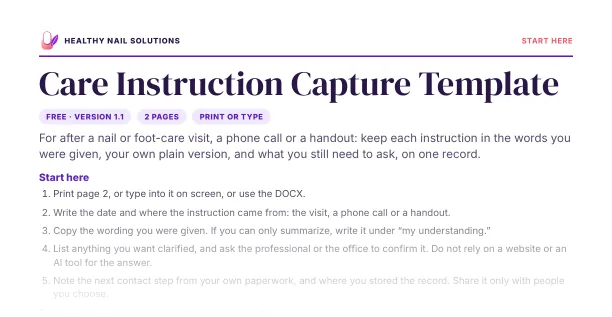
The free Care Instruction Capture Template keeps the instruction as given, your own understanding and the point to clarify apart. Printable PDF and editable DOCX.
Free: enter your first name and email, reply VERIFY to our short email, and we email you the link.

Why “as directed” gets lost on the way home
A spoken instruction can hold three things at once: an order, a time and a condition. A printed label has room for the dose and the warnings, and often keeps “as directed” for the rest. Both are doing their job. Neither is a note you can follow at nine at night.
You are not expected to remember a sequence you heard once. If you want a plain-language picture of what a first visit may involve, see what a nail or foot visit may involve, then come back here with a pen.
The after-visit sheet: four columns
You can draw this on any sheet of paper, or use the free Care Instruction Capture Template. One row per step, in the order you were given.
| Column | What to write | If nobody told you |
|---|---|---|
| Step, in order | One action per line, numbered 1, 2, 3. | Write order not clear and ask. |
| Time of day | Morning, evening, before bed — as told. | Write time not told and who to ask. |
| If a step is missed | What the clinic or pharmacist said, word for word. | Leave blank and call before deciding. |
| Who to call | Clinic, pharmacy and any advice line, with numbers. | Ask at the desk before you leave. |
A blank cell is information: it shows what still needs an answer.
Keep one action per line. A line such as “clean, then apply, then leave it alone” is three steps stacked into one, and the order is the part that gets lost.
Fill it in before you leave
Start with the order, not the details.
Before you stand up, write the steps in the order you were told them. If two came out of order in the conversation, ask which one comes first.
Say it back and let them correct you.
Repeat the steps in your own words and invite a correction. Then write the corrected version. Cross out rather than erase, so you can see what changed.
Ask for the time of day.
Try: “What time of day should this happen, and does it matter if I shift it?” Write the answer next to the step it belongs to.
Ask what to do if a step is missed.
Say it plainly: “If I forget a step, what should I do, and who should I call?” If the answer is “call us,” write the number beside it.
Ask for it in writing.
Ask the person who gave the instruction to check what you wrote. A short written note from the office is easier to follow later than a good memory.
If you also want to prepare questions for the next visit, the free Appointment Question Card has eight question ideas to tick and space for your own three.
The missed-step column
This is the column people leave empty, and it is the one that matters most at nine at night. Write only what you were told. If nobody said, the honest entry is “not told — call” plus the number.
Do not work it out later from the label. A catch-up decision belongs to the clinic or the pharmacist who knows your situation, not to a notebook. Your sheet’s job is to get you to the right person quickly, with the right words ready.
- Write the answer in the words you heard, not a summary.
- Note who said it: the clinician, the nurse, or the pharmacist at the counter.
- If the answer changes with the time of day, write that beside the step too.
Who to call when a label says “as directed”
Put three numbers at the top of the sheet before you fill in any steps. Then, on a bad evening, you are not searching for a phone number with one hand.
The clinic
The office that gave the instruction. Use the main number on your visit paperwork.
The pharmacy
The counter that filled the label. The number is usually on the bag or the receipt.
An advice line
If your paperwork lists a nurse line or after-hours number, add it. If not, leave the space and ask.
Write the numbers on paper as well as in your phone. A sheet you can hand to someone else is more useful than a contact you have to scroll for. When you call, read from the sheet: “My label says as directed, and my note says step 2 is in the evening. Can you confirm the time and what to do if I miss it?”
Write the answer down with the date and who gave it. The free Nail-Care Follow-Up Workbook has a script for that call and a sheet that keeps the reply next to the original wording.
Caregivers: if you are writing down instructions for someone else, ask their permission before you record or share anything, and keep the sheet with their own paperwork.

A fictional example
Here is how one filled sheet might look. The steps are made up to show the layout.
| Step | When | If missed | Who to call |
|---|---|---|---|
| 1. Wash and dry the foot | Evening | Not told | Pharmacy number on the bag |
| 2. Apply the cream the office prescribed to the nail area | Evening, after the foot is dry | Not told — ask the pharmacist | Pharmacy first, then the clinic |
Open question to raise: whether step 1 has to happen at the same time every day.
Record keeping only. Not a patient case or a health result.
Will a free printable actually change anything?
A fair question, especially if you have already spent money on creams, soaks and gadgets that promised to end the problem and did not. It is reasonable to be wary of one more download.
The honest answer: this site sells nothing and has no checkout. The free pages do not treat a nail and cannot tell you what to use. They are paper. What they do is hold the words you were given, in the order you were given them, so the information is still there when the pharmacy queue is behind you.
Downloads are free with your email — a first name and an email address, nothing more. Reply VERIFY to our short confirmation email and we email you the link; four short tip emails follow over 11 days, and then the series ends. We do not ask for health details, symptoms, diagnoses or a list of medicines, and we ask you not to send them. There is no account, and every email has an unsubscribe link at the bottom. Anything you write on a printed page stays on that page.
If you would rather not download anything, that is fine. A plain sheet of paper works exactly as well, and the rest of this article is written for that sheet.
Use what you already have
You do not need special paper. A sheet folded into the pharmacy bag is enough. Draw three columns with a pen and a ruler, or copy the layout above into a notebook you already carry.
If you print on both sides, check one page first. Lumen Learning’s paper basics page explains that opacity is “the degree to which light is prevented from traveling through a paper,” and in practice how well a sheet keeps the back from showing through. You do not want the notes for step 1 to bleed into the boxes for step 4.
If you type your plan instead, name the file with the date first, such as “2026-11-03 after-visit sheet.” In LibreOffice, File > Properties shows the revision number and the date and time a file was last printed, which is a quick way to see which copy is current.
Keep the sheet where you will look at it: on the fridge, in the bag with the item it belongs to, or in the folder you take to appointments. For more on keeping notes readable, see keeping instruction notes short, dated and readable.
A quick check before you leave
- Every step has a number and its own line.
- Each step has a time of day, or the words “not told.”
- The missed-step column says who to ask.
- Three phone numbers are written at the top.
- You can read your own handwriting tomorrow morning.
One page is enough. If you have questions you want to raise next time, write them on a separate sheet and take both with you. The guide to three questions to write before a nail-care appointment shows how to keep that list short.
Sources and editorial notes
- Lumen Learning, Paper basics, retrieved October 18, 2026.
- The Document Foundation, LibreOffice 7.5 Guide, File formats, security and exporting, retrieved October 18, 2026.
The sheet layout and the example are organizational suggestions, not medical advice or a care schedule. Examples are illustrative. Not clinically reviewed. See our Editorial Policy, Review Methodology and Affiliate Disclosure.
Organization tools, not medical advice. This page helps you prepare questions and keep notes. It does not diagnose a nail condition, recommend a treatment or promise a result. For an assessment, speak with a qualified health professional. Educational and medical scope
Keep your notes connected
How to Record Podiatrist Instructions at Your Visit
How often, how long, a missed dose and a clarify box, before you stand up.
Three Questions to Write Before a Nail-Care Appointment
Describe what you noticed, choose three questions, record the answers.
Care Instruction Capture Template
Separate received wording from what you want clarified. Free with your email.
Write it down before you leave.
The free Care Instruction Capture Template keeps the wording you were given, your own understanding and the point to clarify on one page.
Free with your email · PDF and DOCX