How to file 12 weeks of toenail notes for your next visit
If the last cream did not seem to help, the next visit can feel like a coin flip. A dated file gives you something concrete to point to: what you used, when, and what you noticed.
You used the toenail cream the way you were told and waited out the weeks. The nail looks the same to you, or worse, and you cannot say when it changed. Now another appointment is coming, and the worry is not only the nail. It is the visit: a quick look, the same word said out loud again, a prescription printed, and you outside with the questions you had six months ago.
What stings is that you cannot explain why the last round did not seem to help. “I think it’s worse” is all you have, because nothing was written down at the time. That is a paperwork problem. Paperwork problems have plain fixes.
Here is one: a dated file of twelve weeks of notes and photos, with one index page at the front. Not so you can work out what is happening with the nail. So the next visit can start with a short, dated story instead of a shrug, and you still have room to ask the thing that has been worrying you.
Print a twelve-week filing index.
The visit pack builder, part of the free visit kit, prints a blank twelve-week filing index: a row for each week with the dates, the pages filed, anything still to confirm and where it is stored. Letter or A4, standard or large print.
Open the pack builder Free with the visit kit: enter your first name and email, reply VERIFY to our short email, and we email you the link.
Everything below works with the free Nail and Foot-Care Visit Kit, which has notes between visits and a twelve-week filing index, or with the five-page seven-day quick-start planner: printable PDF and editable DOCX files that work offline. Both are free with your first name and email, and both are organization tools, not medical advice.
A calm desk makes it easier to start filing your pages.
Why a dated file helps
“I used a cream and it did not seem to help” is hard to do anything with. A dated page is easier: what you used, when you started and stopped, and what you noticed in between. The next conversation can begin with what you wrote at the time.
A thick or discolored nail is not automatically one thing. The American Academy of Dermatology notes that injury or another nail condition can look like nail fungus, which is one reason a professional assessment matters. Your pages cannot weigh any of that. They give the person looking at your nail a timeline, and they help you remember what you were asked to do last time.
So write down the awkward parts. A cream that stung after four days goes on the page with its date. A record is for accuracy, not for looking like a model patient.
Build a before-and-after story
Photos turn “I think it’s worse” into something two people can look at. You do not need a good camera, just the same setup each time.
Same light, same spot. One room, one time of day, daylight near a window.
Same distance and angle. Rest the foot on the same chair or towel. One whole-foot photo and one close-up is enough.
Date the file. Names like “2026-11-03 foot” sort themselves. Write the same date on that week’s page.
One folder, oldest first. Photos spread across a phone, a laptop and a drawer are not a record yet.
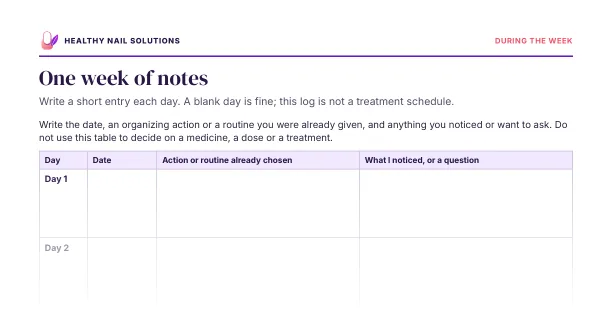
Then add what a photo cannot hold: pain when you walk, a shoe that rubs, anything you started or stopped. Two lines in the weekly notes is plenty, and the index row ties the page to the photo set.
Nothing here interprets a photo, and nobody on this site will see yours. The point is the pair: then, now, and what you wrote in between.
Fictional example · one index row
Week 2 · Nov 10–16 · filed: weekly note, one photo set · to confirm: pharmacy refill date · stored: blue folder, back
Record keeping only. Not a patient case or a health result.
Gather and date your pages
Put every completed page in one place: weekly notes, weekly reviews, question pages and any instruction records. The blank pages get a place of their own, explained in the next section.
Check that each page has a date. On weekly pages, add the week number and the real date range, such as “Week 3 · Nov 17–23.” If a date is unsure, write “date?” in pencil and confirm it later.
Leave the downloaded files alone. Keep the PDF and DOCX as they arrived. When you type in the DOCX, save your version under a new name, such as “planner 2026-11-03.”
Date a working copy on day one, before the first entry, so a part-filled page cannot drift back into the blanks.
Print more pages from your own PDF when you need them, and mark any paper master “Master · copy only.”
Keep blank pages apart from completed notes
Most mix-ups start with one stack that holds everything: clean copies, a half-filled week, the how-to page and the notes from the last visit. Then you write on the last clean copy without noticing, or a private page slides in with the spares you hand to someone helping you. Three labeled places stop both.
Pile
What goes in it
Blanks
A few spare pages with no personal details on them. Print more from your own PDF when they run low.
Reference
The how-to page and the question ideas: anything you reread but never fill in.
Completed
Dated notes, answered question pages and instruction records, oldest first. These are the pages the index below describes.
A folder with two pockets and one large envelope holds all three.
Write those three words on the front of the folder, so anyone helping you can put a page back without asking. A page moves from the blank pile to the completed pile the day you date it, never later.
Instruction records, each kept with the date and source you wrote on it. The free Care Instruction Capture Template keeps the wording you were given apart from your own understanding.
Weeks.
Each weekly notes page followed by its weekly review, split into blocks of four: Weeks 1–4, 5–8 and 9–12, with the real date range on every block label.
A line copied without a date or a source is easy to misread three months later. When an office later answers a question about one of those lines, the free Nail-Care Follow-Up Workbook shows how to file the reply beside the original and mark older copies as superseded. If you are filing someone else’s notes as a caregiver, make sure you have their permission, and keep their pages with their own paperwork.
Make a twelve-week index
The index is one page at the front that says what is in the file and where. The visit pack builder that comes with the free kit prints a blank filing index with one row per week, and its printing options sit on the same page if you need to change the page size. A ruled sheet works too; the columns matter more than the paper.
Oldest at the front, newest at the back is the easiest order to keep, because each new week goes on the end. Write your order on the index so anyone helping you files pages the same way.
Fictional example · a twelve-week archive index
Section
What is inside
Dates
A. Questions
Two question pages, one question card
Nov 3 – Jan 19
B. Instructions
Three instruction records, newest at the back
Nov 3 – Jan 19
C. Weeks 1–4
Weekly notes, reviews and photo dates
Nov 3 – Nov 30
D. Weeks 5–8
Weekly notes, reviews and photo dates
Dec 1 – Dec 28
E. Weeks 9–12
Weekly notes and reviews; one week with no entry
Dec 29 – Jan 25
Open question: ask the office to confirm the next visit date. Order: oldest at the front.
Record keeping only. Not a patient case or a health result.
Pages to take to the visit
You do not need to carry twelve weeks of paper into a small room. Take three things.
The index page.
One sheet showing what the file holds and the dates. It gives the visit a shape in about ten seconds.
The before-and-after summary.
Two dates, two photos, and the lines you wrote about what you noticed. One page.
Your questions.
Write them before you go, not in the waiting room. The question card has eight question ideas and space for answers and follow-ups.
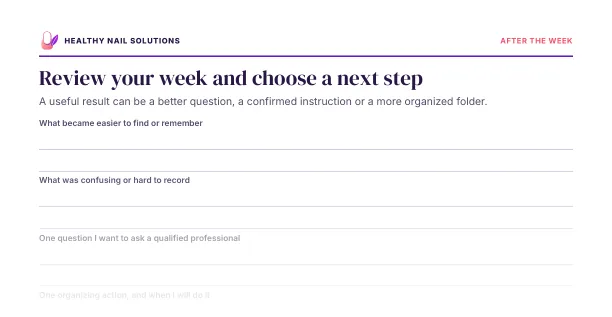
If you freeze, the pages can do some of the talking. Put the question card on your lap or hand it over. Before you leave, write down what you were told: what it is called, what to do next, when to come back, and what would mean calling sooner. Our guide to keeping appointment instructions organized covers that next step.
What this free kit is, and what it is not
You have already spent money on creams, soaks and gadgets that promised a lot. It is fair to ask what a free printable is doing here. The answer is small: it is a place to keep dated pages, and that is all it claims to be.
Free with your first name and email. Reply VERIFY to the short email we send, and the next email brings the download link. Signing up is also the opt-in to a short series of four tip emails over about 11 days, and then the series ends. Nothing is for sale, and every email has an unsubscribe link at the bottom.
No health details, no account. Please do not send photos, symptoms or medicine lists to us. What you write stays on your own device.
PDF (US Letter or A4) and DOCX. Print it, or type in it offline.
Nothing for sale. There is no checkout on this site, no supplement pitch, and no affiliate links on this page. Our buying guides end with Amazon search links; as an Amazon Associate we earn from qualifying purchases.
These pages are educational organization tools, not medical advice, and they are not clinically reviewed. Nobody here has seen your nail and nobody here will.
The honest promise is small. A dated file is easier to hand over than a loose stack of pages. Whether a visit goes differently is not something a printable can decide.
A quick check before you store it
Every page has a date, and weekly pages have a week number.
Section labels show real date ranges.
Blank and completed pages are kept apart.
Photo files are dated and sit in one folder, oldest first.
Instruction wording stays with its date and source.
The index lists every section and any open question.
Questions people ask about filing their notes
Do I need to bring all twelve weeks to the appointment?
No. Bring the index page, a one-page before-and-after summary with two dated photos, and your written questions. Keep the full file at home, or in your bag in case someone asks for a particular week.
What if I missed a week?
Leave the row in the index and write “no entry” with the dates. A gap you have marked is still part of an accurate record; a gap you have filled in from memory later is not.
Can the file tell me whether a cream is working?
No. The file is a dated record of what you used and what you noticed. Whether anything is working is a question for a qualified health professional, and the file gives them a timeline to look at.
Check page size, sleeve thickness and hole pattern.
Sheet protector guide
Evaluation guides only. No products are named or ranked yet. Affiliate Disclosure
Organization tools, not medical advice. This page helps you prepare questions and keep notes. It does not diagnose a nail condition, recommend a treatment or promise a result. For an assessment, speak with a qualified health professional. Educational and medical scope