
Notes & follow-up
How to track nail changes with photos
Sample photos online never match your own nail. A dated log with the same three angles each week gives you something more useful: your own record to describe and compare.
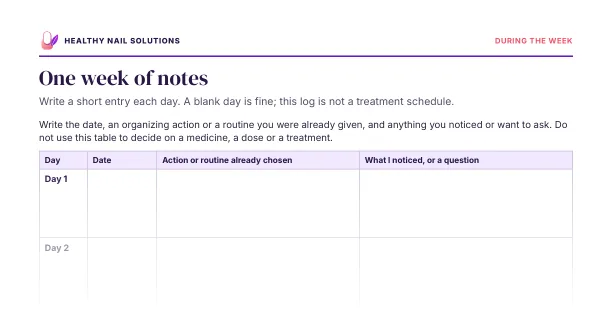
You went looking for a photo of a nail that looks like yours. What you found were close-ups of other people’s hands: a thumbnail under bright light, a chart with eight pictures in a row, a forum post with no date. None of them match the nail you keep checking, and none of them tell you whether the change you noticed last month is the same size now.
Other people’s photos cannot answer that. Your own photos, taken the same way every week, can do something smaller: show you what the surface looked like on a known date, so you are not relying on memory when you describe it later.
That is the routine below. Three fixed angles, one dated folder, one plain line of notes, about five minutes a week. It is record keeping. It does not tell you what a change is, whether it is better or worse, or what to do about it.
Keep your questions and notes in one place.
The free Nail and Foot-Care Visit Kit is 24 pages: a nail map, a photo log, a medicines and products list, questions by type of visit, a visit snapshot and record, and notes between visits. PDF in US Letter or A4, and an editable DOCX.
Free: enter your first name and email, reply VERIFY to our short email, and we email you the link. Then 4 short tip emails over 11 days, each with an unsubscribe link.

What a photo log can and cannot do
A log is paperwork with pictures. Being clear about the difference between recording and assessing is what keeps it honest.
It can
- Put a date on something you noticed.
- Hold the same three views together, week after week.
- Show you which weeks you skipped.
- Give you something specific to describe at a visit.
It cannot
- Say what the change is.
- Decide whether it is better or worse.
- Replace a professional look at the nail.
- Tell you which product, medicine or routine to use.
The American Academy of Dermatology notes that another nail condition, such as nail psoriasis or a nail injury, sometimes looks like nail fungus, and that a dermatologist may take a sample and look at it under a microscope. A photo cannot do that. It only holds your own view still.
Choose three fixed angles
Three views are enough. Choose them once, write them on a card, and take the same three every week so this week’s photo sits beside last week’s without guesswork.
| Angle | Where the camera goes | What the frame holds |
|---|---|---|
| 1. Top | Directly above the nail, lens flat and parallel to it. | The whole nail plate, plus a little skin at the edges. |
| 2. Side | At nail level, from the outer edge of the toe or finger. | The profile: how thick the nail looks and how it sits. |
| 3. Tip-under | Low and in front, looking back under the free edge. | The front edge and what is visible beneath it. |
These are camera positions for your own record, not a way to check for any condition.
Toenails are easier with the foot flat on a low stool or the edge of a chair. Fingernails are easier with the hand flat on a table and the phone resting on a book at the right height. A steady phone beats a steady hand.
Photos for the office are a different set. These three angles are for your own record. If an office wants photos, the AAD’s guide to taking pictures for a dermatologist asks for three pictures from different perspectives; the visit kit’s photo guide (page 7) turns that into where it is, a comparison with the nails around it, and a close-up. Use that set, and send it only the way the office asks. The AAD also says to ask your dermatologist how often to take pictures, because the same condition differs between patients, so a weekly set is a habit for your own notes, not a schedule.
Take them the same way each week
Repetition matters more than photo quality. A plain photo taken the same way for eight weeks beats a beautiful close-up taken once.
Pick one day and write it down.
Sunday evening, or whichever weekday suits you, with a five-minute reminder. If you miss a week, take the photo anyway and label it with the real date.
Use the same light.
Daylight from the same window at roughly the same time, overhead light off. Skip direct sun and skip flash.
Use the same background.
A plain sheet of paper, a plain tile or a plain cloth, so the edge of the nail is easy to see.
Put the date in the frame.
Write the date on a scrap of paper and lay it beside the nail in the top view. If a photo ever leaves its folder, the date goes with it.
- Wipe the lens first.
- Keep the distance the same, with a little space around the nail.
- Use the plain camera app: no filters, no beauty mode.
- Take two of each angle and keep the clearer one.
- Do not crop out the skin around the nail.
Keep one folder per date
Name each folder with the date first, year then month then day, so the list sorts itself. Add a word you will recognize, and use the same name on every photo from that day.
- Nails 2026-11-03 week 1
- Nails 2026-11-10 week 2
- Nails 2026-11-17 week 3
- Nails 2026-11-24 week 4 · side view retaken
Record keeping only. Not a patient case or a health result.
On a computer, make a folder with the same name and drop the photos in. If you prefer paper, print the best of the three and put the sheet in an envelope labeled with the date. Keep the blurred shots too: they are a reminder to steady the phone next week, not a failure.
Write one plain line per photo
The note records what you can see, in words someone else could check. One line per photo, factual. This is harder than it sounds, because the first words that come to mind are usually verdicts.
| Write this | Instead of this |
|---|---|
| “Left big toenail, top view. Yellow from the middle to the tip. Edge uneven.” | “Getting worse.” |
| “Side view. Looks thicker, or the camera was lower this week.” | “Definitely thicker.” |
| “Tip-under view blurred. Retake next week.” | (deleting the photo) |
| “White mark near the cuticle. No idea what it is.” | “Looks like fungus.” |
Illustrative examples. Describing a nail is not the same as assessing it.
Four things are worth a line: color, thickness as it appears in the photo, the shape of the edge, and anything visible under the tip. If you are unsure of a word, describe the shape: “a line across the nail” rather than a medical term you would have to look up.
Keep one line for a question. “Ask whether this is the same area as the first photo” is a note you can carry straight to your next visit.

Keep the log private
Photos of a nail are photos of a body part, and on a phone they sit next to everything else. A few habits keep the log yours.
- Do not post the photos in forums or on social media. Strangers cannot assess them, and a public post is hard to withdraw.
- Do not send photos to us. Our forms ask you not to send health details, and we never ask for pictures. Nothing you keep in your own album or write on a planner page reaches this site.
- Use a locked album or a separate folder if other people share your phone or computer, and keep a backup you can find again.
- Caregivers, ask first. Get permission before you photograph someone else’s nail, and tell them where the pictures are kept.
For printouts, our guide to keeping printed nail-care notes private at home covers storage and sharing a house.
Use the log at your visit
The log earns its keep in the room. Instead of “it has been changing for a while,” you can say “these are the last eight weeks, same three angles, and here is the week I first noticed the edge lifting.”
Bring three questions with it, written before you go rather than assembled in the parking lot. The Appointment Question Card has eight question ideas to tick and space for the answers, and what a nail or foot visit may involve describes what a clinician may look at and ask.
You do not have to hand over your phone. Show one photo, or print the three views from the week you are asking about.
The AAD describes a dermatologist examining both fingernails and toenails, asking about your health and about possible exposure at home, a gym or a pool, and sometimes taking a sample from the nail to look at under a microscope. Its guidance on nail changes also says a dermatologist should examine any nail that is lifting up. Photos can show when you first noticed something; they cannot say why it is happening.
If you have already paid for things that did not work
Fair question: why would a free printable make any difference when creams, soaks and gadgets promised a lot and delivered nothing? The honest answer is that the visit kit is not in that category, because it does not claim to change your nail at all. It is paper. It cannot do what those products promised.
What it does is smaller: it gives what you already notice a date, a place and a set of questions to carry into a visit. That is the part you can control, and it costs about five minutes a week.
Here is the whole exchange, so nothing is a surprise:
- We ask for a first name and an email address so the files can be sent to you.
- You get a printable PDF and an editable DOCX, both of which work offline.
- We do not ask for health details, a diagnosis, a medicine list or photos, and we do not want them.
- There is no account and no checkout. Nothing on this site is for sale.
- Signing up also starts four short tip emails, about two, four, seven and eleven days after you reply VERIFY, and then the series ends. Every email has an unsubscribe link at the bottom.
If that is not a trade you want to make, use the method anyway. A notebook, a phone camera and a folder you already own will do everything described here.
The five-minute weekly routine
Open last week’s folder.
Look at the three angles before you take new ones, so you stand in the same place.
Take the three views.
Top, side, tip-under, with the date card in the top view.
Make this week’s folder.
Year, month, day, then the week number.
Write three lines and one question.
One line per photo: what you see, not what you think it means. Then the question for your next visit.
- Three angles taken, same light and background.
- Date in the frame and in the folder name.
- One plain line per photo, no verdicts.
- Missed weeks labeled with their real dates.
- Photos private, and permission asked before photographing anyone else.
- Questions copied onto the question page.
Sources and editorial notes
- American Academy of Dermatology, Nail fungus: Diagnosis and treatment, retrieved October 18, 2026.
- American Academy of Dermatology, How to take pictures of your skin for your dermatologist, retrieved October 23, 2026.
- American Academy of Dermatology, Nail changes a dermatologist should examine, retrieved October 18, 2026.
A photo log is a record-keeping tool. It does not assess a nail and is not a substitute for advice from a qualified health professional. Examples are illustrative. Not clinically reviewed. See our Editorial Policy, Review Methodology and Affiliate Disclosure.
Organization tools, not medical advice. This page helps you prepare questions and keep notes. It does not diagnose a nail condition, recommend a treatment or promise a result. For an assessment, speak with a qualified health professional. Educational and medical scope
Keep the log connected
How to Make a Simple Nail Map for Your Visit
Draw which nails changed and when, so the visit starts with facts.
How to File Twelve Weeks of Nail-Care Notes
Date weekly pages, group them and keep an index.
What a Nail or Foot Visit May Involve
What sources say may happen at a visit, so you can ask about it.
Print a photo log index.
The visit pack builder that comes with the free kit prints a blank twelve-week index: a row for each week with the dates, what you filed and where it is stored.
Free with the visit kit: enter your first name and email, reply VERIFY to our short email, and we email you the link.