
Appointments & Questions
Questions to ask about nail treatment options
Worried the visit will end with a prescription and no explanation? Here are four groups of questions about options, risks and what to watch for, and a way to take just three.
The question you are afraid to forget
You can picture the visit. The clinician looks at your toenail, says the word fungus, writes a prescription and stands up. You leave holding a paper, with your questions still in your head. You have read about laser treatment and other options that sound expensive, and you are not sure what else to ask.
That worry is reasonable. Appointments are short, and thinking of a good question while someone is writing is hard.
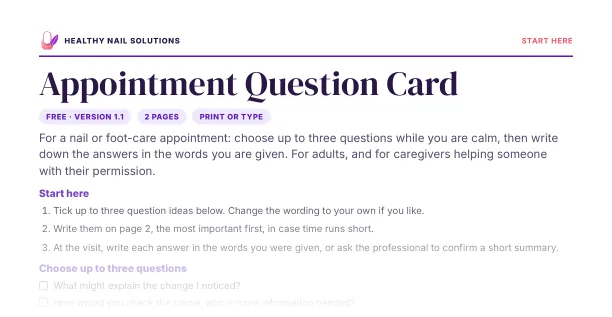
The fix is not more reading. It is a short list about nail treatment, written before you go and kept where you can see it. This page groups question ideas into four clusters, then shows how to cut them to three for the free Appointment Question Card.
Scope. Educational only. This page does not tell you which treatment to use or what your nail condition is. Only someone who examines you can talk through your options, and nothing here replaces advice from a qualified health professional.

Browse 42 question prompts.
The free question prompt bank has 42 prompts in five groups to read and borrow wording from. Choosing your top three and printing them as one page happen in the visit pack builder, part of the free visit kit.
Free to browse. The question page comes with the free kit sign-up and a VERIFY reply.
What a treatment conversation can cover
The American Academy of Dermatology (AAD) describes a dermatologist tailoring a plan to each patient: your health, other medical conditions, the medicines you take, how much nail is affected and the type of fungus involved. Another person’s plan is not a template for yours.
The AAD also says a dermatologist examines fingernails and toenails, asks about your health and possible exposure, and may take a sample to look at under a microscope. That matters because another nail condition, such as nail psoriasis or a nail injury, can sometimes look like nail fungus. A fair first question is what is being checked, and whether a sample is needed.
For treatment, the AAD describes prescription medicine applied to the nail, and notes that a dermatologist may file down the nail surface so the medicine can reach more deeply. It says nails grow slowly, so treatment takes time, and it advises telling your clinician if you are pregnant, planning a pregnancy or breastfeeding.
If you have read about laser treatment or another service, ask about it. Whether it is offered, suitable or within your budget is a local answer that only the clinic can give. For background, see what a nail or foot visit may involve.
Four groups of questions
Copy these, cross them out, rewrite them in your own words. Each group has a job, so you can find the one you need once you are in the room. Two of them have fuller versions: cost questions and side-effect questions.
1. The options offered
- What are you considering for me, and why?
- What else could we try if this does not suit me?
- What should I know about cost or coverage before I decide?
2. Risks and side effects
- What are the common side effects of what you are suggesting?
- What should I do if I notice one?
- Could this affect anything else I take?
3. What happens next
- How long might this take before I notice any change?
- When is the next check, and who arranges it?
- What happens if nothing changes by then?
4. What to watch for
- Which changes mean I should call you rather than wait?
- Is there anything I should avoid while we try this?
- What should I note at home so the next visit is easier?
The AAD notes that redness and swelling around a nail may be an infection, and that a nail lifting up should be examined. Ask which changes matter in your case, and write the answer next to your question.
Pick three, not thirty
Thirty questions is another way of freezing. Three fit on a card, in a pocket and in your head.
One from the options group.
If money is the worry, ask it plainly: “What are the other options, and what do they involve?”
One about risk.
Choose the side effect or interaction you most want to know about before you agree to anything.
The one you would most regret not asking.
You know which one it is. Put it last, so it is not crowded out at the start.
Mark your main question with a star. If the visit is cut short, that is the one you ask. Say at the start that you wrote three questions down. If an answer is unclear, one follow-up does a lot: “Could you say that again in plain words?” If a cost is beyond what you planned for, say so and ask what else could be considered.
Our article on three questions to write before a nail-care appointment walks through a longer version of this exercise.

Write the answers while they are fresh
Before you leave the building, or in the car, put each answer next to its question. Keep the clinician’s wording as given, then add your own understanding on a separate line, so later you can tell which was which. The free Care Instruction Capture Template gives each part its own field.
1. Options: “What else could we try if this does not suit me?” Answer noted, with a review date.
2. Risks: “What should I do if I notice a side effect?” Answer written as given; one point marked to clarify by phone.
Record keeping only. Not a patient case or a health result.
If you are helping someone else, ask their permission before you write down, copy or share anything about them.
About the free card, honestly
You may be thinking: I have already spent money on creams, soaks and gadgets that promised a lot and did not help. Why would a free printout be different, and what does it want from me?
Fair questions, so here is a straight answer. The card treats nothing and cannot make a busy clinic slow down. It is two short pages: three questions with room for the answers, plus a list of question ideas you can draw from. If it does nothing else, it moves your main question out of your head and into your hand.
It asks for a first name and an email address so the download link can be sent to you: reply VERIFY to our short email and the link follows. No purchase or account is needed, and we never ask for health details; we ask you not to send any. The files are static, so nothing you write in them reaches us. You get a printable Letter-size PDF and an editable DOCX, both usable offline. Four short tip emails follow over 11 days, then the series ends, and every email has an unsubscribe link at the bottom.
Before you go, check that your three questions are readable aloud, that your main one is marked, and that anything the office asked for is in one folder. Our paperwork checklist lists the usual items.
Organization tools, not medical advice. This page helps you prepare questions and keep notes. It does not diagnose a nail condition, recommend a treatment or promise a result. For an assessment, speak with a qualified health professional. Educational and medical scope
Common questions
What should I ask about nail treatment options?
Take three written questions: which options the clinician is considering for you and why, what the main risks or side effects are, and which changes mean you should call the office. Write the answers down. Only the clinician who examines you can discuss your options.
How do I ask about the cost of nail treatment?
Ask who can talk to you about cost or coverage, and whether there is anything to know before you decide. If an option is beyond your budget, say so and ask what else could be considered. Costs vary by clinic, so this page cannot quote any.
Does the free question card replace medical advice?
No. It is a blank planning page. It holds three questions and the answers you write. It does not assess your nail or choose a treatment.
Sources and editorial notes
- American Academy of Dermatology, Nail fungus: diagnosis and treatment, retrieved October 18, 2026. Used for: how a plan is tailored to each patient, that a sample may be examined under a microscope, that another nail condition can look like nail fungus, that a plan may include prescription medicine applied to the nail and filing the nail surface, that nails grow slowly, and the advice about pregnancy and breastfeeding.
- American Academy of Dermatology, Nail changes a dermatologist should examine, retrieved October 18, 2026. Used for: redness and swelling around a nail may be an infection, and a nail that is lifting up should be examined.
Examples are illustrative. Not clinically reviewed. See our Editorial Policy, Review Methodology and Affiliate Disclosure.
Keep what you were told.
The Care Instruction Capture Template records the wording as given, your understanding and the point to clarify.
Free · email to download.
Keep your preparation connected
Back to the blogThree Questions to Write Before a Nail-Care Appointment
Describe what you noticed, choose three questions, record the answers.
How to Use Your Question Card When There Is No Desk
Plan a writing surface and keep pages together.
What to Bring to a Nail or Foot-Care Appointment
Ask the office, gather your card and notes, return papers to one place.
Pick three questions before you go.
The free question prompt bank opens in your browser. Choose three, rewrite them in your own words and keep them with your appointment paperwork.
Free to browse. Making and printing your question page comes with the free kit sign-up.