
Appointments & Questions
Side effects of medication: questions to bring to your visit
Three columns on one page — what it is, what to watch for, and what else to ask — so side effects, cost and alternatives are on the table before you leave the room.
“Just a fungus. Take this.”
You already know how this goes. A glance at the nail, one word, a prescription printed and handed across the desk, a hand on the door. Nothing about what the medicine might do to your skin or your stomach. Nothing about why this one and not another. And when something is suggested that costs more than a week of groceries, no hint of what a person on your budget is meant to do instead.
So you leave holding a paper and still carrying the question you walked in with: what am I actually agreeing to?
You cannot make a rushed visit slow down by worrying about it in advance. You can make it harder to rush past you. Three columns of questions, written at your own table, do most of that work.
This page is an organizing method. It is not medical advice, it does not say which medicine is right for you, and it does not tell you how to take one. That conversation belongs with a qualified health professional who has looked at your nail.

Browse 42 question prompts.
The free question prompt bank has 42 prompts in five groups to read and borrow wording from. Choosing your top three and printing them as one page happen in the visit pack builder, part of the free visit kit.
Free to browse. The question page comes with the free kit sign-up and a VERIFY reply.
Three columns, one page
The sheet is not a form. It is three headings with two or three questions under each, in your own handwriting, on one side of one page.
| Column | The question you write | What it gets you |
|---|---|---|
| 1. What it is | “What is this medicine called, and what is it meant to do?” | The name, the goal, and how long the plan runs, in your own notes. |
| 2. What to watch for | “Which side effects are common, and which one should make me call you?” | A short list you can check against, instead of a vague worry. |
| 3. What else to ask | “What will this cost, and what are the other options?” | Cost and alternatives on the table before you agree to anything. |
Questions to ask a qualified health professional. Not medical advice.
Underneath the third column, add one line: the one thing you want from today. That line is the reason the page exists.
The sheet, filled in
Copy this onto paper, or print it. Leave the blanks empty until the visit, then fill them in as the answers come, in the professional’s words rather than yours.
My three columns
What it is. This medicine is called the name on the box. It is meant to what you understood it is for. The plan runs for how long.
What to watch for. Common side effects named: what you were told. The one that means a phone call: what you were told. I will write what I notice on which page or notebook.
What else to ask. Cost with insurance the figure; without it the figure. Other options to read up on: what the professional named. If we wait instead: the answer.
And one request. What I would like from today is the one thing you want.
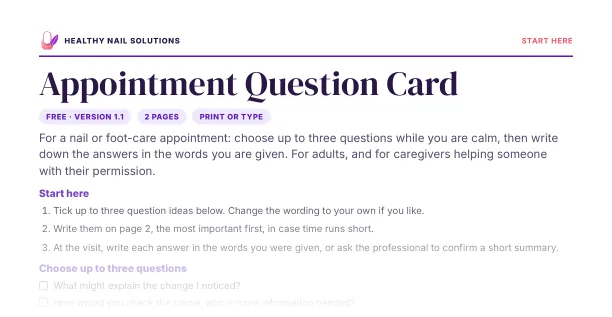
If a blank line is hard to start, the free Appointment Question Card gives you eight question ideas to tick and space for three questions with the answers. A sheet of notebook paper with the same three headings does exactly the same job.
What to watch for, asked plainly
Side effects are usually the shortest sentence of a visit and the longest part of living with a prescription. Ask for them in three pieces: what is common, what means a phone call, and where to write down what you notice.
- “Which side effects are common with this, and when would they usually show up?”
- “Which side effect should make me call your office instead of waiting for the next visit?”
- “Are there everyday things I should change while I am taking it?”
- “Where should I write down what I notice, and who should I tell?”
Then write the answers down before you stand up. Memory is generous in the room and unreliable in the parking lot.
The American Academy of Dermatology’s page on nail fungus diagnosis and treatment (checked October 23, 2026) lists prescription options along with their possible side effects. It describes skin peeling and irritated skin where a topical medicine is applied, an ingrown nail, and, for one oral option, a liver function test before starting and again six weeks later, with liver damage described as possible but rare. That is general information from the AAD, not advice about any medicine you have been offered. The names do not matter for your sheet. What matters is that side effects and monitoring are ordinary parts of a treatment plan, and fair to ask about out loud.
If you are already taking something and something feels wrong, do not work it out from a web page. Contact the prescriber or a pharmacist and say plainly what you noticed and when it started.

What else to ask: cost and alternatives
Cost is a medical question when the answer decides whether you take the treatment. Ask it in the room, not at the pharmacy counter.
- “What will this cost with my insurance, and what would it cost without?”
- “Is there a lower-cost version of the same medicine, and would it do the same job?”
- “What are the options that do not involve a prescription?”
- “What happens if we wait a few months and look again?”
- “If this does not help, what comes next?”
- “If I can’t afford that, what would you rather I ask about?”
None of these is a refusal. They are how you get the map, instead of one road whose toll you cannot pay. And if the list of things you have already bought and tried is long, putting it on one page keeps the recount short and calm. For cost on its own, with what to ask about lab work, separate billing and follow-up visits, see our nail treatment cost questions.
A fictional example of the sheet
What it is: the tablet, one a day, for the number of weeks on the box. What to watch for: the two side effects the office named, which one means a phone call, and the page where I write down what I notice. What else: what this costs without insurance, whether there is a lower-cost version, and what we would try if this does not suit me.
Fictional wording for illustration. Not a patient case and not a health result.
Read it once for the shape: name, watch list, money. Then replace every line with your own. The sheet is a place to hold answers, not a place to guess them — and anything you are unsure about goes back to the professional as another question.
Why a free printable would be any different
It might not be, and that is worth saying plainly. If you have already paid for creams, soaks and gadgets that promised to end the problem and did not, your guard is up, and the guard was earned. Paper will not treat a nail. Nothing on this site does, and there are no supplements, soaks or devices for sale here.
What the free Nail and Foot-Care Visit Kit offers somewhere to keep these questions and the answers: its question lists already include the benefits and risks of each option and whether anything could interact with the medicines on your list, its medicines and products list is page 9, and page 13 holds your three questions with room for the answers. It comes as one 24-page PDF in US Letter or A4, an editable DOCX, or one ZIP with all three. You can print it at home or fill it in on a computer, offline. It promises nothing beyond that.
About the email, since that is usually the sticking point. Downloads here ask for a first name and an email address, because that is how the link reaches you, and the form asks for nothing else: no diagnosis, no medicine list, no photos, no account. You get a short email first; reply VERIFY and the delivery email with the link follows. Replying also starts four short tip emails, about 2, 4, 7 and 11 days later, and then the series ends. Every email has an unsubscribe link at the bottom. The files are static, so nothing you write in them reaches us. Nothing is sold on this site and there is no checkout.
If you would rather not give an email, a sheet of notebook paper with three headings does the same job. The columns are the method. The page is only where they live.
Organization tools, not medical advice. This page helps you prepare questions and keep notes. It does not diagnose a nail condition, recommend a treatment or promise a result. For an assessment, speak with a qualified health professional. Educational and medical scope
Questions people ask
How do I ask about medication side effects without sounding difficult?
Write the question down first and read it aloud if that is easier. “I want to understand the side effects before I start” is a plain sentence and a fair one. Ask which side effects are common, which one means a phone call, and where to write down what you notice. Then write the answers in the professional’s words while you are still in the room.
Where can I read about side effects from medication before my visit?
The patient leaflet that comes in the box, and a pharmacist, are the two quickest places to ask about a medicine you already have. For general context on nail treatment, this site cites the American Academy of Dermatology’s page on nail fungus diagnosis and treatment, which lists prescription options and their possible side effects. Use general pages to prepare questions, not to decide anything; the decision belongs to you and a qualified health professional.
What should I write down if I notice side effects on medication?
Four things: what you noticed, when it started, how often it happens, and anything that seems to set it off. Keep it to one page and take it with you. If something feels wrong now, contact the prescriber or a pharmacist instead of waiting for the next appointment.
The side effects of the medication worry me more than the nail does. Is that fair to say?
Yes. Say it in those words. A professional can only weigh a risk you have told them about, and “I am more worried about the medicine than about the nail” is information, not a complaint. It also opens the conversation about other options, including waiting.
What if the suggested treatment costs more than I can pay?
Say the number out loud, or say that you cannot afford it, and ask what else is possible. Ask about a lower-cost version, about options that do not involve a prescription, and about what happens if you wait and look again in a few months. A plan you cannot pay for is not a plan.
Sources and editorial notes
- American Academy of Dermatology, Nail fungus: diagnosis and treatment, retrieved October 18, 2026. It lists prescription options with possible side effects, including skin peeling and irritated skin where a topical medicine is applied, and notes that one oral option requires a liver function test before starting and again six weeks later, with liver damage described as possible but rare.
Examples are illustrative. Not clinically reviewed. See our Editorial Policy, Review Methodology and Affiliate Disclosure.
The questions are half of it. The answers are the other half.
What you were told, in their words, with the point you want to clarify at the next visit.
Free · email to download
Keep your preparation connected
Back to the blogThree Questions to Write Before a Nail-Care Appointment
Describe what you noticed, choose three questions, record the answers.
Questions to Ask About Nail Treatment Options
Prompt list for options, side effects, and what to watch for.
How to Tell Doctor What I've Tried: A One-Page List
One page listing products, dates, and how long you used each.
Three columns, written before the visit.
What it is, what to watch for, what else to ask — on one page you can hold in your hand.
Free to browse. Downloading the card asks for a first name and email so the link can reach you.