
Notes & follow-up
Six questions to ask a pharmacist after a nail prescription
The visit gave you a prescription, and the sentence about how to use it has already gone soft. Six questions at the pharmacy counter, written down in the pharmacist’s words, put the instructions back on paper before you get home.
You know the drive home from the appointment. You finally showed someone the thick, discolored toenail you have kept hidden in socks for a year. The doctor glanced at it, said fungus, and handed you a prescription. By the time you reached the car, the sentence about how to use it had gone: before or after a shower, how often, for how long. The box went in a drawer. Weeks later it was still there, because the timing and the method were unclear, and guessing felt worse than doing nothing.
That is not a memory problem, and it does not mean you wasted the visit. It means the instructions were spoken once, in a rushed room, and never written down.
The pharmacy counter is the second chance. The US Food and Drug Administration’s tips for talking with your pharmacist (checked October 23, 2026) say your pharmacist can help you learn how to use your prescription and nonprescription medicines safely, and list questions to ask, from how and when to use a medicine to what to do if you miss a dose. This page turns six of them into one sheet you fill in at the counter.
It is an organizing method, not medical advice. It does not say which medicine is right, how much to take or whether to start or stop anything. The answers belong to the pharmacist and the prescriber.
Record instructions in separate columns.
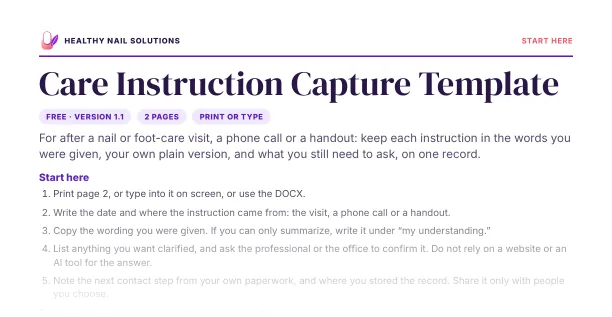
The free Care Instruction Capture Template keeps the instruction as given, your own understanding and the point to clarify apart. Printable PDF and editable DOCX.
Free: enter your first name and email, reply VERIFY to our short email, and we email you the link.
Six pharmacy questions for a toenail fungus prescription
Copy these onto one page with a blank line under each, and leave the lines empty until you are at the counter. Write the answers in the pharmacist’s words, not your summary.
| Ask the pharmacist | The exact answer, in their words |
|---|---|
| 1. How often do I use this, and at what time of day? | write the answer |
| 2. Where exactly does it go, and does anything need to happen first, such as washing and drying the nail? | write the answer |
| 3. How long do I keep using it, and what do I do when it runs out? | write the answer |
| 4. How many refills do I have, and when should I ask for more? | write the answer |
| 5. What should I do about a missed dose? | write the answer |
| 6. Who do I call if something seems wrong or I have another question? | write the answer |
Organization prompts, not medical advice. Questions 1, 2, 3 and 5 follow the FDA’s own list (how and when to use it, any special directions, how long, a missed dose); the rest are record-keeping questions.
Under question 6, write two numbers: the pharmacy number from the receipt and the office number from your appointment slip. Ask which one to try for what. The FDA’s list also includes asking when you should contact your doctor about the medicine.

Read the label together before you leave
A few more minutes at the counter save a phone call later. The FDA’s tips suggest checking, before you leave the pharmacy, that you have the right medicine, and, if you have bought it before, that it has the same shape, color, size, markings and packaging. If anything looks different, ask.
- Ask for the written information. The FDA suggests asking whether there is a medication guide or other patient information for the medicine. Keep it with your sheet.
- Say if the label is hard to read. The FDA lists trouble reading small labels and remembering to take a medicine among the things to tell your pharmacist.
- Read your answers back. “So what I have is once a day, in the morning, for this many weeks. Have I got that right?” Correct the page before you go.
What to tell the pharmacist about your other medicines, supplements and allergies is a conversation for the counter. Tell them directly; please never send that information to this website.
What a filled-in sheet looks like
This is the shape of a completed sheet, not a set of instructions to copy. Yours will say something different, because it will hold what your pharmacist tells you.
| Question | What is written | Still to clarify |
|---|---|---|
| How often, what time | “Once a day, in the morning,” copied from the label and read back to her. | Whether morning means before or after breakfast. |
| Where exactly | She pointed to the words on the label; I copied them exactly. | Nothing. |
| How long, then what | The end date circled on the box, with “ask at the follow-up” written beside it. | What to do if the follow-up is moved. |
| Refills | The number on the label, copied exactly, plus the next step: ask at the November 24 appointment. | Whether the pharmacy will call first. |
| Missed dose | I asked her to write the answer on the sheet; I copied it underneath. | What counts as soon. |
| Who to call | Pharmacy number from the receipt. Office number from the appointment slip. | Which number for which problem. |
Record keeping only. Not a patient case and not a health result.
The free Care Instruction Capture Template has the same columns as a fuller record: date and source, the instruction as given, your understanding and the point to clarify.
Getting ready for the appointment itself
This page starts at the pharmacy. If the appointment is still ahead of you and the worry is being rushed, freezing up or not being taken seriously, start with the visit itself; these pages do that job: what to bring to a nail or foot-care appointment, three questions to write before the visit, recording a podiatrist’s instructions in the room and what a nail or foot visit may involve. If you help someone else with their paperwork, ask their permission before you write anything down or keep a copy.
Why a free printable is worth a try
If you have already spent money on things that promised a lot and did not help, a free printable deserves a hard look. It is fair to think it only wants your email so it can sell you something else. Here is the honest version. The template does not treat anything, and it knows nothing about your nail. It is a sheet with headings, and its only job is that the answer you got at the counter is still readable in March.
- Free with your first name and email. Reply VERIFY to our short confirmation email, and the next email brings the download link. Signing up also starts four short tip emails over about 11 days, and then the series ends. Every email has an unsubscribe link at the bottom.
- No health details, no account, no checkout. Please do not send photos, symptoms or medicine lists to us. There is nothing for sale on this site and no supplement pitch.
- PDF and DOCX, offline. Print the template or type in it. If you want a whole visit record, the free Nail and Foot-Care Visit Kit follows the same idea across the appointment and the weeks after.
This page is educational organization help, not medical advice, and it is not clinically reviewed. Questions about a prescription go to the pharmacist or the prescriber.
Questions people ask at the pharmacy
What if the medicine bottle instructions are hard to read?
Take the bottle to the pharmacy counter and ask the pharmacist to go through the label with you. The FDA’s tips for talking with your pharmacist include telling the pharmacist about trouble reading small labels. Use the six questions in this article and write the answers in the pharmacist’s words.
What should I tell the pharmacist?
The FDA’s tips list the things to tell your pharmacist, including every medicine you use, over-the-counter products and supplements, anything you have stopped taking, and any allergic reactions or problems you have had with medicines. Tell the pharmacist directly; this website never asks for that information.
What if the pharmacist's answer is different from what I heard at the visit?
Write both down, each with who said it and the date, and ask the pharmacist or the prescriber’s office which one to follow. Do not choose between them yourself.
Is the Care Instruction Capture Template really free?
Yes. It is free with your first name and email. There is no checkout, no supplement pitch and no need to send health details.
Before you leave the counter
- All six answers are written in the pharmacist’s words.
- The missed-dose line is answered, or flagged to ask.
- Two phone numbers sit under question 6.
- Any medication guide or printout is folded in with your sheet.
- The sheet has today’s date and goes in your appointment folder.
Sources and editorial notes
- US Food and Drug Administration, Stop - Learn - Go: Tips for Talking with Your Pharmacist to Learn How to Use Medicines Safely, checked October 23, 2026 (what to tell and ask your pharmacist, and what to check before you leave the pharmacy).
The six pharmacy questions are a record-keeping prompt, not a care schedule. Examples are illustrative. Not clinically reviewed. October 23, 2026: this article now leads with the pharmacy questions; general visit preparation moved to the linked articles. See our Editorial Policy, Review Methodology and Affiliate Disclosure.
Organization tools, not medical advice. This page helps you prepare questions and keep notes. It does not diagnose a nail condition, recommend a treatment or promise a result. For an assessment, speak with a qualified health professional. Educational and medical scope
Keep your notes connected
Side Effects of Medication: Questions for Your Visit
A fill-in sheet for risks, side effects, alternatives.
How to Record Podiatrist Instructions at Your Visit
How often, how long, a missed dose and a clarify box, before you stand up.
How to Remember Doctor Instructions After a Visit
Put each step in order and note who to call when unclear.
Write it down at the counter, not in the car.
The free Care Instruction Capture Template keeps the date and source, the instruction as given, your understanding and the point to clarify on one page. Printable PDF and editable DOCX.
Free with your email. No health details and no checkout.