
Notes & follow-up
A toenail changes checklist for your doctor
Ten rows, one for each toenail, filled in from memory and a good look tonight. It gives the visit dates and words to work with, and it gives you two rows to raise first.
Your appointment is next Tuesday. You still have no written record of when the nail first changed, whether it has spread to another toe, or whether anything you tried over the counter did anything at all. Somewhere in the last year the nail started to look different, and the most honest answer you can give is, “I don’t remember.”
What you are dreading is the room. A glance at your foot, the word “fungus,” a prescription, and you outside again before you asked the thing that has been on your mind for months.
One part of that has a plain fix, and it takes one sitting. Tonight, fill in a ten-row table: one row for each toenail, with the first change you noticed, what it looks like now, and the date you last checked it. It is not a diagnosis and it will not stretch the visit. It means you walk in with dates and words instead of a shrug.
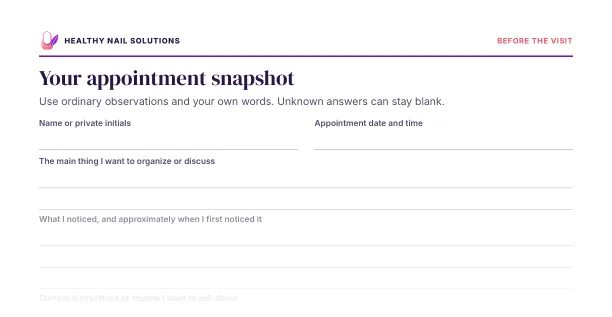
You can rule the table on lined paper. If you would rather start from a form, the free Nail and Foot-Care Visit Kit includes appointment notes, a page of appointment questions and a week of dated pages, as a printable PDF (US Letter or A4) and an editable DOCX that work offline.
Record instructions in separate columns.
The free Care Instruction Capture Template keeps the instruction as given, your own understanding and the point to clarify apart. Printable PDF and editable DOCX.
Free: enter your first name and email, reply VERIFY to our short email, and we email you the link.

Start with a ten-row table
Ten toenails, ten rows. Do not write only the bad one. The rows that say “no change” answer the question about spread, and they take seconds to fill in. Four columns are enough:
- Nail. Right foot, big toe, then the rest, then the left foot.
- First change noticed. Month and year if you have them. “Late last winter” is allowed, with a question mark.
- What it looks like now. Plain words: color, thickness, shape, edge, and anything you feel.
- Date last checked. Tonight’s date, unless you looked more recently.
Here is a made-up set of rows, so you can see how little each cell needs to hold.
| Nail | First change noticed | What it looks like now | Date last checked |
|---|---|---|---|
| Right foot, big toe | About March 2026 (month unsure) | Yellow-brown near the tip, thicker at the edge than last year, no pain | October 26, 2026 |
| Right foot, second toe | Noticed October 2026, no earlier date | Small pale patch near the cuticle | October 26, 2026 |
| Left foot, big toe | Nothing remembered | No change noted | October 26, 2026 |
| Left foot, second toe | Nothing remembered | No change noted | October 26, 2026 |
Record keeping only. Not a patient case or a health result.
Words for changes in nail color and shape
Write what you see, not what you think it is. “Yellow-brown at the tip” is something two people can look at together. “Fungus” is a conclusion, and a conclusion is what you are going in to ask about. Keep a short word list beside the table:
- Color: yellow, brown, a white patch, a dark streak, green-black.
- Surface: a groove across the nail, ridges, a dip in the middle.
- Edge and thickness: thick at the tip, lifting on one side, crumbly under the free edge.
- Feeling: sore in shoes, tender when trimmed, nothing at all.
Changes in nail color have many possible causes. The American Academy of Dermatology notes that a disease inside the body can cause nails to change color, and that another nail condition, such as nail psoriasis or a nail injury, sometimes looks like nail fungus. That is why the words on your page are descriptions to hand over, not a diagnosis to trust.
Date what you can, mark what you can’t
You do not need exact dates. A month and a year is enough to build a timeline, and a marked guess beats a blank.
- Check your phone. Photo dates, texts to family and calendar notes often hold the month you first mentioned the nail.
- Check your order history, if you have one. A pair of shoes you bought because of rubbing can date when something started bothering you.
- Write “date?” in pencil where you are guessing, and fill it in if you later find the photo.
- Leave a gap as a gap. “No entry, April to June” is accurate. A date you invented later is not.
Add a two-minute nail map
A simple map makes the table easier to read in the room. Draw two rough foot shapes on the back of the page and ten small squares for the nails. Number the toes 1 to 5 on each foot, big toe first. Then mark it in pencil:
- A dot in the squares where you noted a change.
- A star on the nail that worries you most.
- The date you drew the map.
That is all a nail map is: a picture of where you looked, not a picture of what it means. If someone asks which toe you mean, you can point instead of counting out loud. Our guide to making a simple nail map for your visit shows a fuller version.

The two rows to raise first
Appointments are short. You will not read out ten rows, and you should not try. Pick two.
Row one: where the timeline starts.
The nail where you first noticed a change, with the earliest date you can support. This is the anchor for everything else you say.
Row two: the one you keep thinking about.
The nail that looks most different now, or the one on your mind at night. Write your question about it in one full sentence before you go.
Keep the whole table in your bag. If the conversation has room, hand it over. If it does not, you will already have said the two things that mattered, and your question will be written down rather than swallowed.
If a nail is painful, or something is changing quickly, say so when you call the office rather than saving it for the appointment. A page cannot tell you how soon to be seen; a qualified health professional can.
Fill it in tonight, in one sitting
Set a timer for twenty minutes and work in this order. Starting with the hardest row is what keeps the page blank.
Write the ten nail names.
Right foot first, big toe to little toe, then the left. Two minutes, and the page is no longer empty.
Fill the “now” column.
Sit down, take your socks off and look at each nail. Write tonight’s date in the last column as you go.
Add one timeline line.
A made-up line reads: “Oct 2025 noticed a yellow edge; Jan 2026 started a product I chose myself; Mar 2026 stopped using it; Oct 2026 the tip looks thicker.” Anything you tried belongs there, with the dates you started and stopped.
What a free printable can and cannot do
If you have tried creams, soaks or gadgets that promised a lot, it is fair to ask why a free page would be any different. Here is the honest answer.
It cannot tell you what is happening with your nail, and it cannot say whether anything you tried helped. It carries no promises about your nail and no claim about any product. What it can do is smaller and real: it turns “I don’t remember” into a dated page you can put on the table.
- Free, with your first name and email. Reply VERIFY to our short confirmation email, and the next email brings the download link. Every email has an unsubscribe link at the bottom.
- No health details and no account. Please do not send photos, symptoms or medicine lists to us. What you write stays on your own device.
- PDF and DOCX. Print it or type in it offline, whichever suits the way you work.
- Nothing is sold on this site. There is no checkout.
This page is an organization tool, not medical advice, and it is not clinically reviewed. Whether a change needs treatment is a question for a qualified health professional.
A five-minute check before Tuesday
- All ten rows are filled, including the ones with no change.
- Every date is real, marked with “date?”, or left as a gap.
- The map has a dot for each noted nail and a star on the one that worries you.
- Two rows are picked, and one question is written in a full sentence.
- The table and your question page are in the same folder or bag.
For the rest of the paperwork, our guide to what to bring to a nail or foot-care appointment covers the folder itself, and three questions to write before a nail-care appointment helps if you only have room for a few.
Questions people ask about the checklist
What if I don’t remember when the nail first changed?
Write the month and year you think you first noticed and add a question mark. Then look for support: a photo date, a text to a family member or a dated receipt. A marked guess with a source beside it is more useful than a blank.
What counts as a change in nail color?
Anything that looks different from your other nails or from how that nail used to look: yellow, brown, a white patch, a dark streak or green-black. Write the word you would use with a friend, note whether you wear polish, and leave the diagnosis out.
Can the checklist tell me whether it is nail fungus?
No. The American Academy of Dermatology notes that another nail condition, such as nail psoriasis or a nail injury, sometimes looks like nail fungus. The table records what you saw and when; what it means is a question for a qualified health professional.
Do I need to bring all ten rows to the appointment?
Bring the page, but you do not need to read it out. Start with the row where the timeline begins and the row that worries you most, then hand the table over if there is time.
Sources and editorial notes
- American Academy of Dermatology, Nail changes a dermatologist should examine, retrieved October 18, 2026.
- American Academy of Dermatology, Nail fungus: diagnosis and treatment, retrieved October 18, 2026.
The ten rows are a filing suggestion, not a symptom test or a care schedule. Examples are illustrative. Not clinically reviewed. See our Editorial Policy, Review Methodology and Affiliate Disclosure.
Organization tools, not medical advice. This page helps you prepare questions and keep notes. It does not diagnose a nail condition, recommend a treatment or promise a result. For an assessment, speak with a qualified health professional. Educational and medical scope
Keep your notes connected
What to Bring to a Nail or Foot-Care Appointment
Ask the office, gather your card and notes, return papers to one place.
Three Questions to Write Before a Nail-Care Appointment
Describe what you noticed, choose three questions, record the answers.
How to Record Podiatrist Instructions at Your Visit
How often, how long, a missed dose and a clarify box, before you stand up.
Fill in the ten rows tonight.
The free Nail and Foot-Care Visit Kit includes appointment notes, a page of question ideas and a week of dated pages, as a printable PDF and an editable DOCX.
Free: enter your first name and email, reply VERIFY to our short email, and we email you the link.