
Notes & follow-up
Prepare for your appointment the night before
Two days out, and still no record of when the nail changed or whether the creams did anything. A short evening routine turns scattered dates into a one-page story you can hand over.
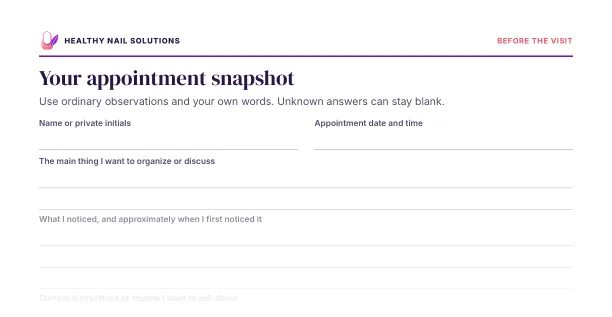
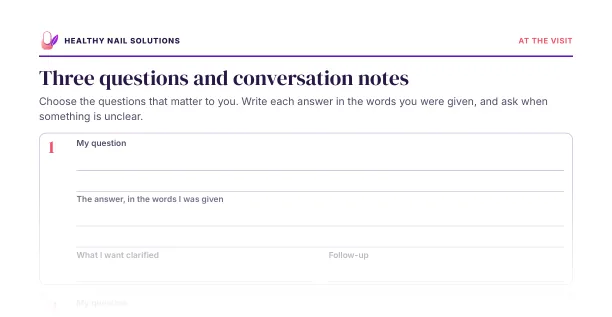
The appointment is next Tuesday, and the record is still empty. You do not know when the nail first began to look different. You are not sure whether the change has spread to the toes beside it. And the over-the-counter creams? You could not say whether any of them did a thing.
Nobody hands you a page to write it on. Months of glancing at your feet in the bathroom light leave nothing behind, and then the visit arrives.
The worry is specific. The doctor looks at the nail, says “fungus,” hands you a prescription, and you are out of the room before you ask the thing that has been on your chest for months.
You do not need six months of tidy notes to change that. You need about 45 minutes tonight: a rough timeline from dates you already have, one filled-in snapshot page, three chosen questions, and a folder by the door.
Browse 42 question prompts.
The free question prompt bank has 42 prompts in five groups to read and borrow wording from. Choosing your top three and printing them as one page happen in the visit pack builder, part of the free visit kit.
Free to browse. The question page comes with the free kit sign-up and a VERIFY reply.
Everything below works with the free Nail and Foot-Care Visit Kit. In the kit, the nail map is page 4, your three questions are page 13 and the visit snapshot and bring list is page 14. The shorter five-page quick-start planner, a separate free file, has a snapshot on page 2 and three questions with conversation notes on page 3. The files come as a printable PDF and an editable DOCX, work offline, and are free with your email. This is an organization tool, not medical advice.

Why the night before is enough
You will not rebuild six months from memory, and you do not have to. A useful record needs three things: when you first noticed, what you have already tried, and what you can see and feel now. Each one usually leaves a footprint somewhere: a photo, a receipt, a calendar entry, a message.
Gaps are allowed. A line that says “date?” in pencil is more honest, and more useful, than a confident guess.
The American Academy of Dermatology’s page on nail fungus describes prescription treatments applied to the nail, some of them for many weeks, and notes that a dermatologist may trim loose nail. A plan that runs for weeks is easy to half-remember on the way home, which is one reason the writing matters.
The 45 minutes at a glance
| Minutes | What you do | What you end with |
|---|---|---|
| 0–15 | Pull dates from photos, receipts and messages | A rough timeline, gaps and all |
| 15–25 | Fill the appointment snapshot page | One page in plain words |
| 25–35 | Choose your three questions | Three questions with room for answers |
| 35–45 | Pack the folder | Everything by the door |
These are planning blocks, not rules. If you only have 20 minutes, do the timeline and the questions.
Minute 0–15: pull the dates you already have
Start with the places that already keep dates for you. You are copying, not remembering.
Photos.
Search your phone’s photo app month by month. Note the earliest date where the nail looks different. If your memory is earlier than the first photo, write both: “noticed around March, first photo May 12.”
Receipts and messages.
Search your email for the pharmacy or the store. A receipt or order email holds a purchase date even when the start date is fuzzy. So does a card statement line, or a message you sent someone.
Anything still in the bathroom.
Boxes and tubes carry labels. Copy the name and put it back; you are only collecting dates and words.
For each cream, soak or gadget, write four short notes: what it was, when you started, when you stopped, and one plain line about what you noticed. “No change after three weeks” is a complete entry.
March 2026 · first noticed the right big toenail looked thicker · no photo yet
May 12 · first photo, right foot · whole foot and one close-up
June 2–June 30 · over-the-counter cream from the pharmacy, twice a day · no change I could see · stopped
Record keeping only. Not a patient case or a health result.
Last, draw a rough map: two ovals for the feet, ten small circles for the nails. Shade the nails you are watching and write the date you first saw a change beside each. You are marking where and when, not what it is.
Minute 15–25: fill the appointment snapshot
The snapshot is one page. In plain words it says who you are seeing and when, why you are going, what you have noticed with dates, what you have tried with dates, anything that makes it worse, and what you want from the visit.
Use your own words. “Thick and yellowish at the tip of the right big toenail; first photo May 12” says more than a word you looked up. If you have a guess, put it in the margin and label it “my guess.” A guess written as fact can follow you through the whole visit.
Two lines are enough for what you want: “I want to know what you think this is, and what the next few months look like,” and “I want to know what to do if nothing changes.”
Minute 25–35: choose three questions
Three is not a magic number. It is what tends to survive a rushed visit. The free Appointment Question Card gives you eight question ideas to tick and a page for your own three, with room for the answer, anything to clarify, and a follow-up.
- What do you think this is, in plain words? Ask for a name you can understand.
- What happens next, and when? This covers the plan and the timing.
- What would mean I should call sooner? Write the answer exactly as you are told it.
If one question has been worrying you for months, put it first and write it the way you would say it out loud. Saying the words once, alone, is what stops you freezing later. Our guide to three questions to write before a nail-care appointment goes further into wording.
Under each question, leave a line for the answer and a line for “clarify.”

Minute 35–45: pack the folder
Everything fits in one folder, and the folder goes by the door tonight, not on the hall table tomorrow morning.
- The snapshot page. One page, face up.
- The timeline and the map. Behind the snapshot.
- Your three questions. On top, where you can reach them.
- A blank page for what you are told. The free Care Instruction Capture Template keeps the wording you were given apart from your own understanding.
- A pen that works. Two, if you have them.
- Whatever the office asked for. Check their reminder message rather than guessing.
Please do not email photos, symptoms or medicine lists to us. We do not ask for them. What you write stays on your own device and in your own folder. Our paperwork checklist covers the same ground if you want a second pass.
A Tuesday visit, worked through
Here is the same plan as one evening, for a visit on Tuesday morning.
6:30–6:45 · three dates collected: a photo from May 12, a pharmacy receipt from June 2, a message from March
6:45–7:00 · snapshot filled in on one page: what I noticed, what I tried, what I want from the visit
7:00–7:10 · three questions chosen, written in the words I would say aloud
7:10–7:20 · folder packed: snapshot, timeline, map, questions, blank page, two pens
Record keeping only. Not a patient case or a health result.
But will a free printable change anything?
Fair question, and you have earned the right to ask it. You have already paid for creams, soaks and gadgets that promised a lot and did not deliver. A printable cannot tell you what is happening with your nail. It cannot make a treatment work, and it cannot promise that the visit goes differently.
What it can do is narrower. It gives the dates and the words somewhere to live, so the visit does not start with “I don’t remember.” That is the whole claim.
About the email. The kit is free with your first name and email. You reply VERIFY to a short confirmation email, and the next email brings the download link. Signing up is also the opt-in to four short tip emails over about 11 days; then the series ends, and every email has an unsubscribe link at the bottom. Nothing is for sale on this site, and we do not ask for health details or an account.
The pages are not clinically reviewed, and nobody here has seen your nail. They are organization tools, and they say so.
Before bed: a five-minute check
- Every timeline entry has a date, a date range, or “date?” in pencil.
- Each cream, soak or gadget has a start, a stop, and one line about what you noticed.
- The snapshot fits on one page and uses your own words.
- Three questions are written, with room for an answer.
- The folder is by the door with a pen inside.
- If you are preparing for someone else, you have their permission to write down and share their information.
Then stop for the night. The pages do not need to be perfect. They need to be in the folder.
Sources and editorial notes
- American Academy of Dermatology, Nail fungus: diagnosis and treatment, retrieved October 18, 2026.
The 45-minute plan is an organizing routine, not a care schedule. Examples are illustrative. Not clinically reviewed. See our Editorial Policy, Review Methodology and Affiliate Disclosure.
Organization tools, not medical advice. This page helps you prepare questions and keep notes. It does not diagnose a nail condition, recommend a treatment or promise a result. For an assessment, speak with a qualified health professional. Educational and medical scope
Keep your planning connected
Three Questions to Write Before a Nail-Care Appointment
Describe what you noticed, choose three questions, record the answers.
What to Bring to a Nail or Foot-Care Appointment
Ask the office, gather your card and notes, return papers to one place.
How to File Twelve Weeks of Nail-Care Notes
Date weekly pages, group them and keep an index.
Write your three questions tonight.
The Appointment Question Card has eight question ideas to tick and a page for your own three, with room for the answer, anything to clarify, and a follow-up.
Free: enter your first name and email, reply VERIFY to our short email, and we email you the link.