
Notes & follow-up
How to stick to a nail care routine with a dated check-off sheet
You heard “twice a day for six months,” nodded, and by the car it had faded to “whenever.” A printed check-off sheet turns that timeline into dated boxes you tick.
Record keeping only. Your clinician sets the steps and the timeline.
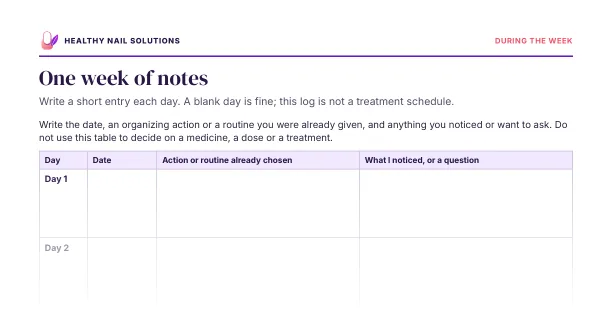
“Apply it twice a day for six months.” You heard it in the room, you nodded, and maybe you wrote nothing down. By the car it had softened to “apply it whenever.” Three weeks later the tube was back in a drawer and the routine had quietly stopped.
That is not a character flaw. Spoken instructions are easy to lose, especially at the end of a short visit you had been dreading. You may have spent weeks working up to it and left with less than you hoped to ask. You may also keep your feet out of sight, and dread a next appointment where the doctor glances at the nail, says the word, writes something and is gone before your real question is out.
This article is about one small fix for the first problem: how to stick to a nail care routine by copying the timeline you were given into a dated check-off sheet, ticking a box after each step, and keeping a notes-for-next-visit line at the bottom of the page. The sheet records your routine. It is not a treatment schedule, and it does not tell you what to use or how often.
Record instructions in separate columns.
The free Care Instruction Capture Template keeps the instruction as given, your own understanding and the point to clarify apart. Printable PDF and editable DOCX.
Free: enter your first name and email, reply VERIFY to our short email, and we email you the link.

Write the timeline down while it is fresh
Copy the instruction down before you leave the room, or as soon as you sit in the car. Put three things beside the wording: the date, who gave it, and what you understood it to mean. The free Care Instruction Capture Template has a field for each, plus a column for a point to clarify, so a half-heard sentence becomes a question instead of a guess.
Oct 20 · clinic visit · “Apply the prescribed product twice a day; review in six months.” My understanding: morning and evening. To clarify: what to do about a missed dose.
Illustrative record keeping only. Not a patient case or a health result.
The steps themselves come from a qualified health professional, not from a printable. The AAD’s page on nail fungus: diagnosis and treatment describes, for example, that after a nail or part of a nail is removed, you care for the treated area at home and your dermatologist gives you the instructions for that care. Most routines follow the same logic: the timeline is theirs to set, and yours to copy accurately.
If something was not clear, write it down as a question rather than filling in the gap yourself. Our guide to three questions to write before a nail-care appointment helps you plan the ask for next time.
Turn the timeline into a check-off grid
A grid is a table with days down the page and steps across the top. It works because each row asks one small question you can answer in two seconds: did I do this step today, yes or no?
Put a real date on every row.
“Day 1” is hard to place three months later. A date lets you find the week that slipped, and it matches the dates on your other paperwork.
Give every step its own box.
If the timeline has two steps a day, that is two boxes. One box marked “done” for the whole day hides exactly what you wanted to keep track of.
Keep a notes-for-next-visit line.
Questions go here while they are fresh: a missed step, whether the review date still stands, anything that changed. The free Appointment Question Card has question ideas you can copy into this line.
| Date | Morning step | Evening step | Notes for next visit |
|---|---|---|---|
| Mon, Nov 2 | done | done | — |
| Tue, Nov 3 | done | missed — late shift | Ask what to do about a missed step |
| Wed, Nov 4 | done | done | — |
| Thu, Nov 5 | done | done | Is the review still in May? |
| Fri, Nov 6 | done | done | — |
Record keeping only. The steps and the timeline come from your clinician, not from this sheet.
If you print a week at a time from the PDF, keep the blank master clean and file the finished page when the week ends. If you use the editable DOCX, save a new copy for each week, dated in the file name, so you never overwrite a week you already filled in.
Keep the sheet where the step happens
A sheet in a folder in another room is a sheet you will skip. Tape the current week inside a cabinet door, or keep it in the same drawer as the item it refers to, with a pen clipped to it.
- One place, so nothing has to be hunted for.
- One pen kept with the sheet, so ticking takes no setup.
- One week per page, dated at the top.
When the week ends, move the finished page to your appointment folder. The next blank week then starts in the same spot, which is what makes the routine easy to pick up again.
How to stick to a routine when a day goes missing
Missed days are normal. The sheet is there to record them, not to grade you. A few habits keep one missed evening from ending the whole plan:
- Mark the miss and move on. Write “missed” with a short reason if you know it. Do not backfill later or leave a blank you cannot explain.
- Do not invent a catch-up plan. What to do about a missed step is a question for your clinician. Write it in the notes line and ask at your next visit.
- Start again on the next row. A gap in the grid is information, not a failure, and one row is easier to restart than one blurred month.
- Read the notes line before every appointment. That is how a question from November does not wait until spring.
If someone helps you with the routine, agree on who ticks the sheet, so a step is not counted twice or skipped in silence. If you keep notes for another person, get their permission first, and keep their pages with their own paperwork.

The sheet records your routine. It is not a treatment schedule
This distinction matters, and page 17 of the free visit kit says it in print: notes between visits are a record, not a treatment schedule. Your clinician decides what the steps are, how often they happen, and when to stop or change anything. The grid answers a much smaller question: did I do the step today?
That is deliberately modest. A check-off sheet promises nothing about the nail itself. It gives you a dated place to write down what you did, so your next conversation starts from facts instead of a vague sense of having tried.
This page is educational organization help, not medical advice. Your clinician sets the steps, the timeline and any changes.
Set realistic expectations for a long timeline
Some timelines run for months rather than days, and nails change slowly. The same AAD page notes that if an entire fingernail is removed, it can take six months or longer to regrow, and that toenails can take 12 to 18 months. Those figures describe regrowth after a procedure, not a promise about your own timeline; whatever your clinician gave you is the one to plan around.
A dated grid does one useful thing across that stretch: it shows the shape of what you actually did, week by week. That is far easier to bring to a visit than trying to remember a season. Neat ticks help too, and our guide to keeping instruction notes short, dated and readable has small adjustments that keep old pages readable.
Why a free printable sheet can still help
You may have already spent money on creams, soaks and gadgets that promised to end the problem and did not. A fair question follows: why would a free printable make any difference, and does it just want your email so someone can sell you something else?
Honest answer: the sheet does not touch your nail, and it does not tell you what to use. It solves a narrower problem. An instruction spoken once has no shape; a dated grid gives it one. If your routine keeps slipping, the grid will show where and why, and that becomes a better question at your next visit.
The Nail and Foot-Care Visit Kit is free to download with your first name and email address. There are no health questions, no account and no checkout. The files work offline: a printable PDF in US Letter or A4, and an editable DOCX. Nothing you write in them reaches us, and every email has an unsubscribe link at the bottom. The privacy policy lists exactly what is collected, in plain language.
Nothing on this site is sold today. No paid product exists: an earlier paid toolkit proposal was withdrawn, and the toolkit page has the current status.
Questions about sticking to a routine
How do I stick to a routine when I keep forgetting the instructions?
Write them down at the visit, with the date and who gave them, then copy them onto the top of the sheet. The sheet carries the memory so you do not have to.
What is the easiest way to stick to a daily routine?
Match the sheet to the day you actually have: one row per day, one box per step, one place to keep it and one pen. Tick after the step, not before.
How do you make a routine and stick to it for months?
Print short blocks, one week at a time, date each page and file the finished pages in date order. Before each appointment, read the notes line and take the pages with you.
What if I miss a day?
Mark it, write a short reason if you know it, and ask your clinician what to do next. Do not invent a catch-up plan on your own.
A quick check before your next visit
- Every row has a real date, not just a day number.
- Each step in the timeline has its own box.
- Missed days are marked, not erased.
- The notes line holds your questions for the visit.
- The finished page goes into the same folder as your appointment paperwork.
Sources and editorial notes
- American Academy of Dermatology, Nail fungus: diagnosis and treatment, retrieved October 18, 2026.
The check-off grid, the notes line and the filing suggestions are organization tools, not clinical direction. Examples are illustrative. This page is educational and is not medical advice; ask a qualified health professional about your own care. Not clinically reviewed. See our Editorial Policy, Review Methodology and Affiliate Disclosure.
Two free pages that do the writing
Capture the instruction first
Date, source, the wording as given, your understanding and a point to clarify.
Care Instruction Capture TemplateTurn gaps into questions
Eight question ideas to tick, plus space for your own three questions.
Appointment Question CardFree resources, both as a printable PDF and an editable DOCX. See all free resources
Organization tools, not medical advice. This page helps you prepare questions and keep notes. It does not diagnose a nail condition, recommend a treatment or promise a result. For an assessment, speak with a qualified health professional. Educational and medical scope
Keep your routine connected
How to Record Podiatrist Instructions at Your Visit
How often, how long, a missed dose and a clarify box, before you stand up.
Three Questions to Write Before a Nail-Care Appointment
Describe what you noticed, choose three questions, record the answers.
How to Remember Doctor Instructions After a Visit
Put each step in order and note who to call when unclear.
Print the sheet that carries the memory.
The free Nail and Foot-Care Visit Kit has dated notes between visits, a follow-up tracker and a twelve-week filing index, in PDF and DOCX.
Free · email to download.