
Caregivers & privacy
Your nail-care handover: explaining the visit at home
The visit is over and the plan is still in your head. One page, written during the appointment, lets you hand the answers and next steps to the person at home.
Your partner asks a fair question at the kitchen table: “So what did the doctor say?” And you cannot answer it. You sat in the room for the whole visit. You nodded. You left with a plan you can half repeat, a copay receipt and the same worry you walked in with.
That is not a memory problem. It is a paper problem. A short appointment produces a lot of spoken information and nothing to hold it. By evening, “she said something about a prescription and coming back” is all that is left, and it does not explain anything to anyone.
This page builds the last step of the visit: a one-page summary you can hand over at home. It shows the questions you asked, what you were told in the words you were given, the points still to confirm and the next step. You write the middle at the appointment. The handover takes about five minutes.
Underneath your partner’s question is a specific fear. The visit will be quick: a glance at the nail, the word “fungus,” a prescription, and a hand on the door. Or you will freeze, the thing that has been worrying you will stay unsaid, and six months from now you will still be hiding your feet. A written page does not slow a busy clinic down. It does mean the part you most want to ask has already been said, by you, from a line you wrote at home.

Browse 42 question prompts.
The free question prompt bank has 42 prompts in five groups to read and borrow wording from. Choosing your top three and printing them as one page happen in the visit pack builder, part of the free visit kit.
Free to browse. The question page comes with the free kit sign-up and a VERIFY reply.
What a free page can and cannot do
You may have spent money on a cream, a soak or a gadget that promised a lot and delivered very little. A printable does not change that, and this one does not pretend to. A page cannot tell you what is happening with your nail, cannot say which product to use and cannot replace the visit. Only a qualified professional can assess a nail.
What a page can do is narrower and genuinely useful. It holds your questions so you do not freeze. It holds the answers in the words you were given instead of your later summary of them. And it keeps the next step in one place you can both read.
About the free files: they are free, and they ask for a first name and an email address. Not symptoms, not photos, not an insurance number, not an account. Every email has an unsubscribe link at the bottom. Each file comes as a printable PDF and an editable DOCX, so you can print it or type in it offline. Nothing is sold on this site and there is no checkout.
Before the visit: three questions, one of them uncomfortable
Write three, not twelve. Three questions you will actually ask beat a page of good intentions. The free Appointment Question Card gives you eight question ideas to tick and a second page for your three questions, each with room for the answer, a point to clarify and a follow-up.
- What do you think is happening with this nail, and what else can look like it?
- What are the options, and what does each one involve in practice?
- What should I do at home, and what should I not do?
- I have already tried a few things. Is it useful if I list them and say when I stopped?
- What would tell us it is working, and when should this be looked at again?
Then write the uncomfortable one. It is usually the question you would rather not say out loud: “I have been hiding my feet. Is this something you see often?” or “I am not sure this is what it was called last time.” Put it on the card in your own words. A written line is far easier to read out than a sentence you have to invent in the room, and it is the one you would regret leaving unsaid.
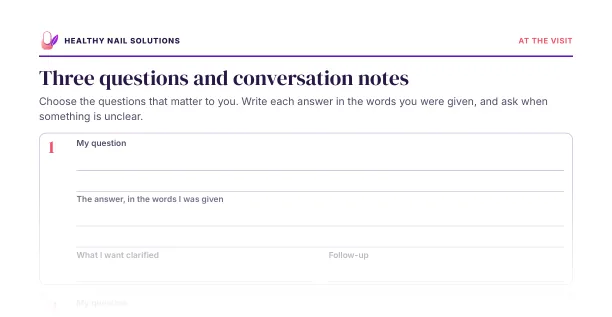
In the room: write the answer as it was given
Bring the card in your hand, not at the bottom of a bag. Hold it on your lap or the chair arm, because there is rarely a desk. Our guide to writing appointment notes without a desk covers the small practical moves.
Ask the first question early.
“I wrote down three questions so I do not lose them” is a normal way to start. It gives the clinician something to work with and gets the awkward part over.
Copy their words, not your version.
Write what was said as it was said, even if the sentence is clumsy. If it was long, ask them to slow down rather than tidy it up later.
Say when you do not follow.
“Can you say that in plain words?” is a fair request. Write the plain version next to the word you did not know.
Mark gaps instead of guessing.
If an answer did not come, write “to confirm” and move on. A gap you can see is better than a guess you cannot check.
One point worth asking about directly: the American Academy of Dermatology notes that a dermatologist may include a procedure as part of a treatment plan, and that you should not try to scrape white discoloration from a nail at home, because it is a medical procedure that needs experience and the right tools. The same page notes that lasers are not FDA approved to treat nail fungus. If you have been looking at a gadget or an at-home tool, that is a question for the office, not a purchase to make in the parking lot.
Build the one-page visit summary
Back in the car, before you start the engine, spend five minutes turning the card into one page. The free Nail and Foot-Care Visit Kit has a visit record page (page 15) that fits this job, and a plain sheet of paper works just as well.
| Part of the page | What goes there | Fictional entry |
|---|---|---|
| Date and place | The date, and who you saw by role | “14 October, foot clinic appointment” |
| Three questions | Your lines, copied from the card | “What do you think is going on?” · “What are the options?” · “What should I not do at home?” |
| Answers, as given | Their words, one line under each question | Written during the visit, nothing added later |
| Still to confirm | Any point you did not follow, marked clearly | “To confirm: which date the handout means for a review” |
| Next step | Who does what, and by when | “Call the front desk on 22 October to confirm the next date” |
| Who has a copy | Named people, and how many copies exist | “One copy, kitchen folder; read by my partner, no copy kept” |
Record keeping only. Not a real person, a patient case or a health result.
Notice what the page does not contain: no diagnosis you wrote yourself, no product names, no guesses. It is a record of what was said and what happens next. That is exactly what your partner is asking for.

Hand it over at the kitchen table
Give the page to your partner before the questions start. Then read it together, out loud if that helps. You are not performing a summary from memory; you are both reading the same page. Where it is thin, say so. “That part is still to confirm” is a real answer and a good one.
This page covers the talk after the visit. If the harder conversation comes before it, when “just go to the doctor” keeps ending the discussion, our guide on how to tell your partner about a doctor visit has a four-sentence script to read aloud.
Then agree the next step in one line: who contacts whom, about what, and by when. Write it on the page with the date. If the call is yours, put your name against it. If your partner is making it, write theirs.
If you are passing notes on for someone else, such as a parent or a neighbor you drive, check with that person first about what may be shared and who may see it. This is their information. The free Care Instruction Capture Template does the same job in more detail when instructions arrive by phone or on a printed handout.
Keep the page findable and private
One page is either easy to find or easy to lose, depending on where it lives. Choose the place now: the inside pocket of the folder that goes to appointments, or a drawer you both know. Print a second copy only if you truly need one, because every extra copy is another page to keep track of. If the page goes on the fridge, decide who may read it before it goes up.
Our guide to keeping printed nail-care notes private at home covers the practical side. If you carry notes to appointments often, the evaluation guide to portable document organizers lists what to check about size, closure and pockets. A folder you already own may be enough.
This page organizes paperwork. It does not assess a nail, choose a product or decide on care. Questions about a nail or foot concern go to a qualified health professional.
The handover checklist
Print this page or copy the boxes onto the front of your folder.
Before the visit
- Three questions written on the card, one line each.
- The uncomfortable question written down, not just remembered.
- A short list of what you have already tried and when you stopped.
- A pen that works and a page that fits your bag.
In the room
- First question asked in the first few minutes.
- Answers copied in the words used, with “to confirm” where you were unsure.
- The next step written as who, what and by when.
At home
- The page handed over and read together.
- Your partner’s questions added in a different pen, with a date.
- One private place chosen for the page; extra copies avoided or shredded.
Sources and editorial notes
- American Academy of Dermatology, Nail fungus: diagnosis and treatment, retrieved October 18, 2026.
Examples are illustrative. Not clinically reviewed. See our Editorial Policy, Review Methodology and Affiliate Disclosure.
Organization tools, not medical advice. This page helps you prepare questions and keep notes. It does not diagnose a nail condition, recommend a treatment or promise a result. For an assessment, speak with a qualified health professional. Educational and medical scope
Keep your paperwork connected
What to Bring to a Nail or Foot-Care Appointment
Ask the office, gather your card and notes, return papers to one place.
How to Record Podiatrist Instructions at Your Visit
How often, how long, a missed dose and a clarify box, before you stand up.
Three Questions to Write Before a Nail-Care Appointment
Describe what you noticed, choose three questions, record the answers.
Start with one question.
Choose your three questions first. The free visit kit costs nothing; the downloads ask only for your first name and email.
Free: enter your first name and email, reply VERIFY to our short email, and we email you the link. Then 4 short tip emails over 11 days, each with an unsubscribe link. Nothing is for sale.