
Notes & follow-up
Teach-back method: repeat the instructions before you leave
Spoken instructions fade by the parking lot. A 60-second read-back before you leave keeps the exact words, the correction, and the one question you still need answered.
The pharmacy bag went on the counter and stayed there. You heard the instructions in the room, nodded, maybe repeated a word back. Then you drove home, and somewhere between the parking lot and the kitchen the timing went soft: morning or night, before or after a shower. The bag sat unopened, and the worry that you had misunderstood it sat with it.
That is not carelessness. Spoken instructions are hard to hold when you are still taking in what was just said about your nail and half standing up to leave. If your own notes for yourself end up on the back of an envelope in the car, that is normal too. It is not a character flaw; it is a paperwork gap.
The fix is small, and it happens before you leave the room: a 60-second read-back. You say the instructions back in your own words. The person who gave them tells you what is off. You write the correction down exactly as they said it.
Record instructions in separate columns.
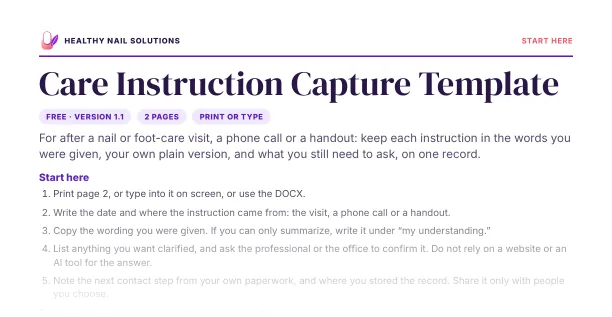
The free Care Instruction Capture Template keeps the instruction as given, your own understanding and the point to clarify apart. Printable PDF and editable DOCX.
Free: enter your first name and email, reply VERIFY to our short email, and we email you the link.
The record page of the free Care Instruction Capture Template holds all of it: a two-page PDF and an editable DOCX, printable and usable offline, free with your first name and email. It is an organization tool, not medical advice.

What the teach-back method is
Teach-back is a checking step, not a test. You explain the instructions back in your own words, and the person who gave them says plainly whether that matches. Where it does not, they correct it while you are both still in the room.
You do not need the clinic to use a name for it. You can ask for the check yourself, in one sentence: “Can I say that back to you, so I get it right?” A nod means “I heard you,” not “I can repeat that back.” The read-back is what shows the difference.
Teach-back is about instructions, not diagnosis. A thick or discolored nail is not automatically one thing; the American Academy of Dermatology notes that injury or another nail condition can look like nail fungus, which is one reason a professional assessment matters. Nothing here replaces one.
A 60-second read-back script
Five steps, run standing up with your coat over your arm.
Ask for the minute.
“Before I go, can I say back what I’m going to do, so I get it right?” Asking is allowed, and it takes less time than the phone call you would otherwise make from home.
Say back three things.
What to do, when or how often, and what would mean calling the office sooner. Three sentences, your words.
Stop and let them correct you.
This is the part people skip. If you keep explaining, you fill the silence and the correction never arrives.
Ask the one thing you still do not know.
“The part I’m still unsure about is —” and then the sentence you rehearsed. One question asked out loud beats three you were too rushed to ask.
Date it.
Add the date and the role of the person who spoke, using the wording on the door rather than a name you might spell wrong.
If you only have the nerve for one sentence, make it this one: “Can I say that back to you?”
The correction box: their exact words
Two boxes side by side: what you understood, and what they said instead. Do not wipe out your first version. Seeing “I thought mornings” next to “evenings, after your shower” is how you catch the detail that would otherwise stay wrong for weeks.
| Instruction as given | The short version, in their words. |
|---|---|
| My words back | What you actually said out loud, even if it was wrong. |
| The correction | The exact words they used to fix it. Quotation marks help. |
| Date and who | The visit date and the role of the person who said it. |
| Stored | Which folder or pocket the page lives in. |
A paraphrase drifts. “Twice a day” quietly becomes “a couple of times” once it has passed through two people.
A box for what still needs clarifying
Leave the room with one line still open if that is the honest position. Label it clearly: Still to clarify. Write the question, leave ruled lines under it, and add the date and source when an answer arrives.
- Morning or evening, and does it fit around a shower, a shift or a commute?
- What does the schedule look like on a day when the routine falls apart?
- What would mean calling the office sooner rather than waiting for the next visit?
- Who do I call, and when is the next check?
If the room ran out of time, the question goes to the office afterward. The free Nail-Care Follow-Up Workbook is built for that loop: one unclear line becomes a specific question, then a dated reply, then a next step written beside the original.

Fictional example: a timing detail caught before leaving
| Field | What was written |
|---|---|
| Instruction as given | “Use it once a day.” |
| My words back | “So every morning before work, once.” |
| The correction | “Evenings, after your shower — mornings are the rushed part of your day.” |
| Still to clarify | What to do on a night away from home. Asked at the desk; answer written in. |
| Date and who | 3 November · the clinician who examined my nail |
Record keeping only. Not a patient case or a health result. Instructions belong to the clinician who gives them, not to this site.
Two things happened there. A wrong detail was fixed before it became three weeks of the wrong routine, and the leftover question was settled at the desk instead of in a phone call from the car.
Write three lines first, then file the page
The read-back works better when the words are already on paper: two minutes the night before, or five in the waiting room.
- Line 1: what I think I am going to do.
- Line 2: when, and how often.
- Line 3: what would mean calling the office sooner.
Write in pencil so the lines can be corrected, and read from the page if your mind goes blank; nobody is grading you. If someone comes with you and writes for you, say at the start who is writing. Caregivers: ask permission before you record or share another person’s information, and keep their pages with their own paperwork.
Then file it before the day ends: date at the top, one page per visit, and an older page marked “superseded” if it no longer applies. The free Appointment Question Card covers the questions side, and our guide to recording instructions at a visit covers the longer version.
Why a free printable, and what it does not do
If you have tried creams or soaks and the question is still open, it is fair to ask why a free page would be different, and whether it is just a way to collect an email.
The honest answer is small. A printable cannot change what a clinician tells you, and it cannot tell you whether anything is working. It can hold the words while you are still in the building and leave a visible line for the question you have carried for months. That is a paperwork job. There is no checkout here, no supplement pitch, and no claim that anything ends a nail problem.
These pages are educational organization tools, not medical advice, and they are not clinically reviewed. Nobody here has seen your nail.
For a fuller set of pages for one visit, the free Nail and Foot-Care Visit Kit is the same idea at a larger size.
A check before you stand up
- I said the instructions back in my own words, and I wrote the correction in their words.
- The page shows the date and who gave the instruction.
- My one open question is written, with room for the answer.
- The page is in my folder, not my coat pocket.
Questions people ask about teach-back
What is the teach-back method?
It is a checking step at the end of a visit. You say the instructions back in your own words, and the person who gave them tells you plainly whether you have it right, correcting anything you missed while you are both still in the room.
Can you show a teach-back example?
Say: “So I use it once a day, in the evenings after my shower, and I call the office if it stings. Is that right?” The clinician then corrects the part you got wrong, and you write that correction in their exact words on your record page.
Where does the teach-back idea come from?
The idea is simple enough to use without a name for it. MedlinePlus, in its guide to talking with your doctor, suggests telling the doctor what you understood and asking whether you have it right, so anything unclear can be corrected before you leave. You can ask for this check even if your clinic does not use a name for it.
What if I freeze and forget the script?
Write the three read-back lines on your record page before you go and hand the page over. Reading from paper is allowed, and it is faster than trying to recall a sentence under pressure.
Sources and editorial notes
- American Academy of Dermatology, Nail fungus: diagnosis and treatment, retrieved October 18, 2026.
- MedlinePlus, Talking With Your Doctor, retrieved October 18, 2026.
The read-back script is a note-taking routine, not a care schedule. Examples are illustrative. Not clinically reviewed. See our Editorial Policy, Review Methodology and Affiliate Disclosure.
Organization tools, not medical advice. This page helps you prepare questions and keep notes. It does not diagnose a nail condition, recommend a treatment or promise a result. For an assessment, speak with a qualified health professional. Educational and medical scope
Keep your notes connected
How to Record Podiatrist Instructions at Your Visit
How often, how long, a missed dose and a clarify box, before you stand up.
Three Questions to Write Before a Nail-Care Appointment
Describe what you noticed, choose three questions, record the answers.
Take the instruction record with you.
Two pages: five how-to steps, a fictional example table, and a blank record with fields for the instruction as given, your understanding, the correction, the part to clarify and where it is stored.
Free: enter your first name and email, reply VERIFY to our short email, and we email you the link.