
Notes & follow-up
Questions about nail culture results: what to ask
A result sheet or visit handout can read like it was written for someone else. Three columns and one short call turn the page into an answer you can find again.
You come out of the appointment with a handout in tiny print and words that belong in a lab. It is written for the person who ordered the test, not for the person whose nail was sampled. You fold it, put it in the drawer with the last few, and nothing about your week changes.
That is the worry: that you waste the visit. The doctor glances at your nail, says fungus, hands you a prescription and rushes out. You freeze, the thing that has been worrying you stays unsaid, and six months later you are still hiding your feet.
You do not need to become a lab reader. You need one page with three columns and one short phone call. The exact words on the page go on the left. Your plain guess goes in the middle. The question you will ask goes on the right. Read the questions to the office, write the answer in their words, and add the date.
If no sample was taken, use the doctor’s handout or the after-visit summary instead. The method is the same.
Record instructions in separate columns.
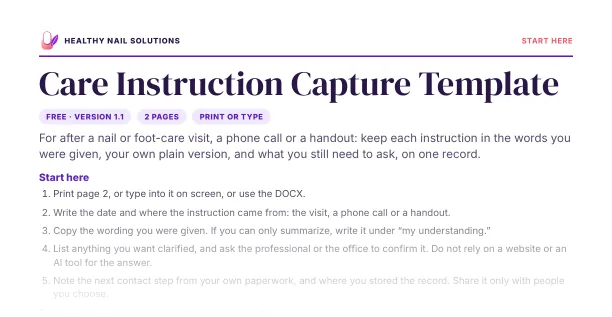
The free Care Instruction Capture Template keeps the instruction as given, your own understanding and the point to clarify apart. Printable PDF and editable DOCX.
Free: enter your first name and email, reply VERIFY to our short email, and we email you the link.
This is record keeping, not medical advice. Nothing here reads or explains a lab result. Nobody here has seen your nail. The aim is smaller: help you ask a better question and keep the answer where you can find it.

Start with the paper you already have
Do not retype the whole sheet. Keep the original and work beside it.
- Find the page that mentions your nail. That may be a culture result, a visit handout or an after-visit summary. Start with the newest page that has the words you do not understand.
- Write two facts in the top corner: the date you received the page and the clinic or lab named on it.
- Circle, do not rewrite. Circle the words you do not understand in pencil. If the print is small, copy just those words in large letters on your worksheet.
- Look for a line that says whether the report is complete. If you cannot tell, that becomes your first question.
If you keep notes for someone else, get their permission before you call about their result or file their pages with yours.
Three columns do the work
Three rules keep the page honest. The left column is copied, not paraphrased: exact words, spelling and all. The middle column is your guess, so write it in pencil and let it be wrong. The right column is a question, not a conclusion.
| The exact words on the page | What I think it means | The question I will ask |
|---|---|---|
| “specimen”, copied as written | the piece of nail that was sent away | Which nail was sampled, and on what date? |
| a word the doctor said out loud that I did not catch | no idea — I only remember the first letter | Can you say that word slowly and spell it for me? |
| a line near the top about whether this is the last version | maybe this is not the final report | Is this the final report, or will another version follow? |
| a line from the handout that I understand but that worries me | the part I want to ask about first | Who can talk me through this line, and when are they available? |
Record keeping only. Not a patient case or a health result.
Three or four rows are plenty for one call. If half the page is circled, pick the questions that change what you do next week; the rest can wait for the next visit.
The page is not the whole conversation. The American Academy of Dermatology (AAD) describes how a dermatologist checks for nail fungus: examining both fingernails and toenails, checking for color change and buildup beneath a nail, asking about your health and possible exposure, and possibly taking a sample from a nail that is looked at under a microscope. The same page notes that another nail condition, such as nail psoriasis or a nail injury, can look like nail fungus. That is why the right-hand column is worth more than the guess in the middle.
A short phone script
You are not asking the office to teach you medicine. You are asking what the words on a page they sent you mean. That is a fair question, and a script keeps it short.
Pick three questions.
Take them from the right-hand column, in the order that matters most to you. Number them.
Open with who and what.
Say your name, the date of your appointment and whether a sample was taken. Then say you have three short questions about the words on the page.
Read question one exactly as written, then stop.
Give the person time to look up your record. Silence on the line is not rudeness; it is someone reading.
Write the answer in their words, then read it back.
“So what I am writing down is…” It takes ten seconds and catches most mix-ups. If you cannot spell a term, ask.
Ask what happens next, and who does it.
Then ask who to call if you have not heard anything. Write down the name of the person you spoke with.
Called Nov 12, 10:40 a.m., spoke with the front desk.
My question: is this the final report? Answer as given: “The report on file is final. The doctor will go over it with you at the follow-up.” Next step: bring the sheet to the follow-up on Dec 3. Asked who to call if I have to move that date.
Record keeping only. Not a patient case or a health result.
Nothing you write in the middle column should change what you do about your nail before you have spoken to the office. A guess waits for the call.
Date every answer
An answer without a date and a name is a rumor. Every line you add needs three parts: what was said, who said it and the day you heard it. With those three, anyone can check the line later.
The free Care Instruction Capture Template is built for this step. It keeps the wording you were given apart from your own understanding and adds a space for the point you still want to clarify and what you did about it. It comes as a printable PDF and an editable DOCX, and it works offline.
If a later call replaces an earlier answer, do not erase the first line. Write the new line underneath, mark the older one superseded with its date and keep both. File the answer with the result sheet or handout, not in a separate notebook. The original and the plain-language note are one document from now on.
If the words still do not make sense
Sometimes the person answering the phone cannot answer a clinical question, and that is not a brush-off. Ask who can, and when they are usually reachable, and write that name down. Then try three things.
- Ask for everyday words. “Can you say that in plain language?” is a normal request, not a silly one.
- Ask whether the answer can be put in writing or added to your visit summary, and where you would find it.
- Move the question to the next visit. Add it to the top of your visit page, with the answer space left blank.
If you freeze in the room, let the paper talk. Put your one page on the desk or hand it over. Our guides to keeping appointment instructions organized, remembering doctor instructions and the teach-back method cover what to write before you leave.
Why a free printable, when creams have already cost you
Fair question. You have spent money on creams, soaks and gadgets that promised a lot and did not help, and a free PDF can look like the same pitch at a lower price.
The honest answer is small. This page claims nothing about your nail. It cannot tell you what a result means and it will not change what your clinician says. It is a dated page for the words, the questions, the answers and the dates, so they are not spread across a drawer, a phone and your memory.
- Free with your first name and email. The template is a PDF and an editable DOCX that works offline.
- No health details, no account. Please do not send photos, symptoms or medicine lists to us. What you write stays on your own device.
- Nothing for sale. There is no checkout on this site and no supplement pitch.
About the email. Downloads are free with your first name and email; the form asks nothing about your health. Reply VERIFY to our short confirmation email, and the delivery email brings your link. After that come 5 short tip emails over 12 days, then at most one email a week, when we publish a new guide. Every email has an unsubscribe link at the bottom. What we send, and when
These pages are educational organization tools, not medical advice, and they are not clinically reviewed. The office that ordered your test is the place to ask what the result means. If no test was ordered, the office that saw you is still the place to ask about your handout.
Check your page before you file it
- The exact words are copied, not paraphrased.
- The middle column is in pencil and says when I do not know.
- No more than three questions are marked for the call.
- Each answer has a date, a name and the words I was given.
- An older answer that was replaced is marked superseded, not erased.
- The note sits with the result sheet or handout, and any open question has a date to follow up.
Questions people ask about a result sheet
Can you tell me what my culture result means?
No. Nothing here interprets a lab result, and nobody here has seen your nail or your sheet. The office that ordered the test is the place to ask. This page helps you write the question down and record the answer with a date.
Does this work if I never had a sample taken?
Yes. Use the doctor’s handout or the after-visit summary in place of a result sheet. Copy the words you do not understand into the left column, write your guess in the middle, and put your question on the right.
What if the office says the doctor will talk it through at my next visit?
Write that down as the answer, with the date and the name of the person who said it. Add your questions to your visit page and ask whether anything needs doing before then.
Sources and editorial notes
- American Academy of Dermatology, Nail fungus: diagnosis and treatment, retrieved October 18, 2026.
The three-column worksheet and phone script are record-keeping suggestions, not instructions for interpreting a test. Examples are illustrative. Not clinically reviewed. See our Editorial Policy, Review Methodology and Affiliate Disclosure.
Organization tools, not medical advice. This page helps you prepare questions and keep notes. It does not diagnose a nail condition, recommend a treatment or promise a result. For an assessment, speak with a qualified health professional. Educational and medical scope
Keep your answers connected
How to Record Podiatrist Instructions at Your Visit
How often, how long, a missed dose and a clarify box, before you stand up.
How to Remember Doctor Instructions After a Visit
Put each step in order and note who to call when unclear.
Teach Back Method: Repeat Instructions Before You Leave
Repeat your notes back in 60 seconds and fix them in the room.
Keep the answer with the date.
The free Care Instruction Capture Template gives you a dated place for the exact words, your own understanding and the point to clarify.
Free: enter your first name and email, reply VERIFY to our short email, and we email you the link.