
Notes & follow-up
Printable medication chart PDF: a six-field dose card
Two weeks or four? A small card holds the exact words, the dates and the question to ask, so the next visit starts with paper instead of a shrug.
Two weeks or four? That is the question that keeps coming back. You can hear something about twice a day, and you can picture the prescription being printed, but the number of weeks has gone. The nail still looks the same, so one evening the tube goes in a drawer. Not because anyone said to stop. Because nothing was written down, and “a while” is hard to keep doing.
The visit is its own worry. A quick look, the word fungus, a prescription, and the door. You leave with the question you meant to ask still in your mouth, and six months later you are still pulling your socks on in another room.
One part of that is fixable with paper. A card with six fields holds the exact words, how often, how long, the start and end dates, and a box for what to do if you forget a dose. That last box is not for us to fill in. It is for the person who gave you the instruction.
Record instructions in separate columns.
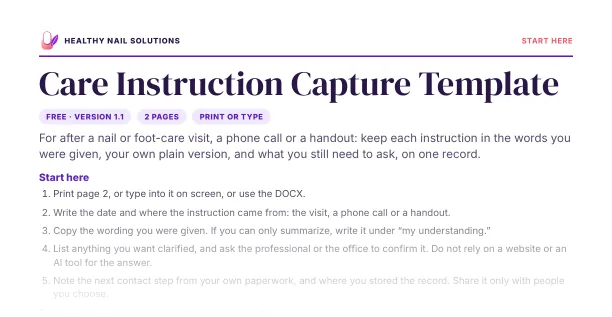
The free Care Instruction Capture Template keeps the instruction as given, your own understanding and the point to clarify apart. Printable PDF and editable DOCX.
Free: enter your first name and email, reply VERIFY to our short email, and we email you the link.
Below is the card, a worked example, and two questions for the pharmacy counter. A blank index card works. If you want a printed shape to follow, the free Care Instruction Capture Template does a neighboring job: it keeps the instruction as given apart from your own understanding, and it has a line for the point you still need to clarify.

Write the words, not your summary
Most people write a summary: “cream twice a day for a while.” That is what memory produces when it is unsure. The card asks for something harder and more useful: the sentence as it was said, in quotation marks, with the date and the name of the person who said it.
If there is no clear sentence, ask for one. “Could you say the routine once more, slowly, so I can write it down?” is a fair request, and it takes about twenty seconds.
The American Academy of Dermatology, on its page about nail fungus treatment, describes prescription routines with a daily application and a set number of weeks, and it tells patients to keep using the medication for as long as prescribed even if symptoms begin to go away. Whatever routine you leave with, the number of weeks and the words “as prescribed” are the parts a memory drops first. Writing them down is not medical advice. It is spelling.
Fill the card in the room, even if it feels awkward for twenty seconds. A card filled in an hour later is a card filled in from memory.
The six fields on the card
One card per instruction. Six fields, always in this order, so a card filled in six months from now looks like this one.
| Field | What goes in it | Who fills it in |
|---|---|---|
| 1. Exact words | The sentence as it was said, in quotation marks. | You, in the room |
| 2. How often | “Once a day,” “twice a day,” “every other day” — their words, not yours. | You, in the room |
| 3. How long | “Four weeks,” “until the review,” or the date it runs to. | You, in the room |
| 4. Start date | The real date you start, written on that day. | You, at home |
| 5. End date | Worked out once from field 3, or “to confirm” if it is not clear. | You, at home |
| 6. What to do if I forget a dose | Their answer, their name, and the date you asked. | The prescriber or pharmacist |
A format for recording instructions, not a treatment plan.
Field six is the one people skip, and the one that gets you on the phone at nine at night, wondering whether to skip the dose, take two, or start the week again. Leave the box blank until you can ask. Then write the answer in their words, with the date and their name.
If field six is empty and a dose is missed, the card cannot answer for you. Phone the pharmacy or the office, and write down what they tell you.
A fictional worked example
The small details are what make a card usable months later. This one is made up to show the shape, not to suggest a routine.
| Field | What is written |
|---|---|
| Exact words | “Use the cream once a day at night. Four weeks.” |
| How often | Once a day, at night |
| How long | Four weeks |
| Start date | 3 November |
| End date | 30 November |
| What to do if I forget a dose | “Call the pharmacy and ask.” — pharmacist, 3 November |
Record keeping only. Not a real prescription, not advice about any medicine, and not a patient case.
Three things are worth copying. The start date was written on the day, not remembered later. The end date was worked out once, in daylight, from the number of weeks. And field six stayed blank until there was someone to ask.
Two questions at the pharmacy counter
The counter is often the last place you speak to someone who knows the routine. Two questions cover most of it.
“Could you check these dates against what is written here?”
Hand the card over. If the count is off, correct it in front of them and add a line saying who checked it and when.
“What should I write in the box about missing a dose?”
Ask them to say it in their own words, then write it down exactly, with the date and their name. “Call us and ask” is a complete answer. Write it as spoken.
If you are collecting medicine for someone else, get their permission before you write anything about them on a card, and keep the card with their paperwork rather than yours.
And if you freeze at the counter, hand the card across. Paper asks the question for you.

Print it or type it in
Paper is faster in a small room; a phone is easy to lose under a coat. The card works either way, and the free template comes as a printable PDF and an editable DOCX, so you can print a few copies or type one at home and print that.
- Keep a blank master. Print one copy, write “Master · copy only” on it, and fill in the copies. Keeping blank pages apart explains why this saves the last clean sheet.
- Write for a stranger. Dark ink, one line per field, no codes that only you understand. Short, dated, readable lines has the details.
- File it the same day. Put the card with your question pages and any handouts, so the next visit starts with one folder. Our guide to keeping appointment instructions organized shows one way.
If a PDF prints too large or too small for your folder, the page-size and printing options are on the help page. The questions you want to ask belong on the Appointment Question Card, which is a separate sheet on purpose.
Why a free printable, and what it will not do
A fair question sits behind this page: you have already spent money on creams, soaks and gadgets that promised to end the problem, and none of it did. Why would a free sheet of paper be any different?
It will not be different in the way you are hoping. It will not change what is happening with your nail, and it cannot tell you whether anything is working. Nobody here has seen your nail, and nobody here will.
What it can do is small and real. It keeps the words you were given in one place, with dates, so the next visit starts with a card instead of a shrug. If the last routine ended early and you are not sure why, this is how you find out.
- Free with your first name and email. Reply VERIFY to the short email we send, and the next email brings the download link. Signing up is also the opt-in to four short tip emails over about 11 days, and then the series ends. Every email has an unsubscribe link at the bottom.
- No health details, no account. Please do not send photos, symptoms, diagnoses or medicine lists. What you write on a card stays on your paper or your own device.
- Nothing for sale. There is no checkout on this site and no supplement pitch. The files are printable and editable, and they work offline.
These pages are educational organization tools, not medical advice, and they are not clinically reviewed. Questions about a medicine, a dose or a missed dose belong with your prescriber or pharmacist.
A quick check before you file the card
- One card per instruction, with the exact words in quotation marks.
- How often, how long, start date and end date are all filled in.
- Every date is a real date, not just “week 1”.
- The name of the person who gave the instruction is written on it.
- Field six has an answer, or is clearly marked as still to ask.
- The card is in the folder with your other appointment papers.
Questions people ask about a printable medication chart
Where can I get a free printable medication chart PDF?
On this site: the Care Instruction Capture Template, a two-page printable PDF with an editable DOCX twin. It is free with your first name and email; reply VERIFY to our short email and we email you the link.
Is this also a daily medicine schedule printable?
Not quite. A daily chart with tick boxes is for marking doses as you take them. This card records the instruction once, with its dates. If you look for a free daily medication chart printable elsewhere, check who made it and what they collect before you sign up.
Can I use the printable medication chart template for more than one medicine?
Use a separate card for each instruction. Two cards in one folder are easier to check than two columns on a single page, and you can hand over one without showing the other.
What do I write in the box about missing a dose?
Nothing, until you ask. Leave it blank, ask the prescriber or the pharmacist, then write their answer in their words with the date and their name. This site does not answer that question for you.
Do I need to send you anything about my health?
No. We ask for a first name and an email only. Please do not send photos, symptoms, diagnoses or medicine lists, and there is no account to set up.
Sources and editorial notes
- American Academy of Dermatology, Nail fungus: diagnosis and treatment, retrieved October 18, 2026.
The six-field card is a record-keeping format, not a treatment schedule. Examples are illustrative. Not clinically reviewed. See our Editorial Policy, Review Methodology and Affiliate Disclosure.
Organization tools, not medical advice. This page helps you prepare questions and keep notes. It does not diagnose a nail condition, recommend a treatment or promise a result. For an assessment, speak with a qualified health professional. Educational and medical scope
Keep the card connected
How to Record Podiatrist Instructions at Your Visit
How often, how long, a missed dose and a clarify box, before you stand up.
Care Instruction Capture Template
Separate received wording from what you want clarified. Free with your email.
One card for the words you were given.
The Care Instruction Capture Template prints as a two-page PDF and opens as an editable DOCX. Page 1 shows a worked example; page 2 is a blank instruction record.
Free with your email: enter your first name and email, reply VERIFY to our short email, and we email you the link.