
Appointments & Questions
Prepare for your podiatrist appointment in a week
The appointment is next Tuesday and nothing is written down yet. Three short evenings give you a dated timeline, a simple nail map and three questions, so the visit starts with facts.
Educational organizing help. Not medical advice.
Tuesday is coming and the page is blank
You can picture the moment. The appointment is next Tuesday, and someone in the room asks when you first noticed the change. You hear yourself say, “I don’t really remember.” Not the month. Not whether a second toe joined in. Not whether the drugstore cream did anything, or whether you only hoped it did.
That is not carelessness. A slow change spread across a year of ordinary days leaves nothing behind unless somebody writes it down. This page is organizing help, not medical advice. It does not say what is happening to your nail. It gives you three evenings of about 15 minutes that end with a dated page, a small drawing and three written questions.

Browse 42 question prompts.
The free question prompt bank has 42 prompts in five groups to read and borrow wording from. Choosing your top three and printing them as one page happen in the visit pack builder, part of the free visit kit.
Free to browse. The question page comes with the free kit sign-up and a VERIFY reply.
Three evenings, three short tasks
Write the appointment date at the top of a sheet, then work backward. With a Tuesday visit, the three evenings can land on Friday, Saturday and Sunday, and Monday stays free for packing. Shift the days if your appointment falls early in the week.
| Evening | 15-minute task | What you have when you stop |
|---|---|---|
| Night one | Dates and timeline | Your dates in order, in your own words |
| Night two | A simple nail map | One drawing of both feet, toes numbered |
| Night three | Three written questions | Three questions with room under each for answers |
| Monday | Pack the folder | One folder by the door, five minutes |
A suggested order of work, not a schedule you have to keep.
Two rules keep this short. Where you do not know something exactly, write an approximate word — “about April,” “I think it was winter” — because an honest approximation beats a blank line. And stop when the 15 minutes end, even mid-sentence.
Night one: put your dates in order
One page, five lines, oldest first.
| Line | What to write |
|---|---|
| First time I noticed | The month and year, as close as you can get, plus the one thing you saw |
| What changed since | Plain description in your words: thicker, a color line, lifting at the tip |
| Other toes or nails | Which ones, and when you first thought so |
| What I tried | What kind of product or routine, when you started, when you stopped |
| Other things I remember | An injury, tight shoes, a pedicure, someone else at home with a similar-looking nail |
The last line earns its place. The American Academy of Dermatology’s page on nail fungus: diagnosis and treatment describes the clinician asking questions to find out whether you were exposed to nail fungus, such as at home or at a gym or pool. One plain sentence about a shared bathroom or a gym answers that before it is asked.
First noticed: about April last year, a yellow line down the right big toenail · Since then: thicker, and the tip lifts when I trim it · Other toes: I think the second toe changed in the fall · Tried: a drugstore cream for about six weeks, stopped when the tube ran out · Other: new tight work shoes in January
Record keeping only. Fictional wording for illustration; not a patient case or a health result.
Night two: draw a simple nail map
Take a second sheet and draw the outline of both feet. Five small circles on each outline will do, and nobody is grading the drawing.
- Write L and R beside the two outlines.
- Number the toes 1 to 5, big toe to little toe.
- Put an X on every nail you plan to ask about.
- Under the drawing, write the date and one plain word for what you see on each marked nail.
The map answers a question you may not manage aloud: is it one nail or several? It also gives you something to point at, which is easier than describing a nail while a stranger waits. Our guide to making a simple nail map shows a fuller version, with room for a date beside each mark. A drawing is a record of what you saw, not an answer about what it means.

Night three: three questions, written down
People freeze in appointments for a plain reason: the questions are in their head, and the room moves faster than they expected. Questions on paper do not freeze.
Choose three, give each its own line, and leave three or four blank lines underneath. Four ideas, in words you would actually use:
- “What could this be, and what helps you tell the difference?”
- “What happens next, and when should I expect to hear about it?”
- “Is there anything I should stop or change while we wait?”
- “Could I have the main points in writing?”
If one question has been sitting in your chest for months, make it question one and write it in the plainest words you have. Reading a written line aloud is still asking.
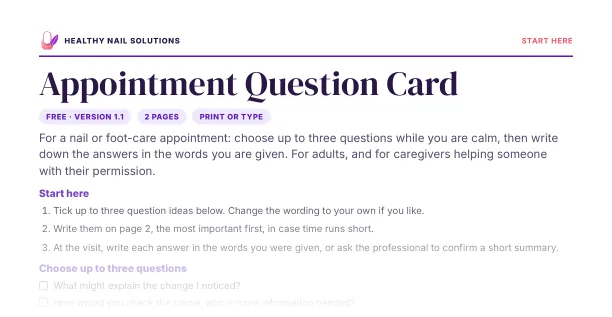
The free Appointment Question Card has eight question ideas to tick and a second page headed “My three appointment questions,” with fields for the answer, a point to clarify and a follow-up. A blank sheet does the same job, so use whichever is in front of you.
Rehearse a 30-second doctor visit summary
A doctor visit summary is your own short answer to “what brings you in?” — not a report and not a diagnosis. Fill in five lines on the same evening, and you have a doctor visit summary template you can read from.
| Template line | Your words |
|---|---|
| I first noticed… | A month and year, and the one thing you saw |
| Since then… | What changed, described plainly |
| I have tried… | What, roughly when, and for how long |
| I am here because… | The reason you booked, in one sentence |
| My main question is… | The one answer you most want |
A fill-in summary for your own notes. It contains no advice and no conclusions.
The MedlinePlus page on talking with your doctor suggests writing down a description of your symptoms, including when they started and what makes them better and worse, taking notes during the appointment, asking questions until you understand, and asking for written instructions if you need them. The five lines above are a short version of that. To rehearse out loud, see practicing a doctor visit summary in 30 seconds.
The AAD page describes a nail examination that includes both fingernails and toenails, questions about your health, and sometimes a sample looked at under a microscope, because another nail condition such as nail psoriasis or a nail injury sometimes looks like nail fungus. A podiatry appointment may follow a different path. Our page on what a nail or foot visit may involve covers the parts that tend to repeat.
Why would a free printable be different this time?
Fair question, and it deserves an answer without a pitch. If you have already spent money on creams, soaks and gadgets that promised a lot and did not deliver, your guard is up, and it should be. Nothing is sold on this site: no supplements, no soaks, no devices, no checkout and no account. A printable cannot change a nail, and this page will not pretend otherwise. What it can do is hold the pages from those three evenings in one place, with the date at the top.
About the email, since that is the part that makes people wary. Downloads here ask for a first name and an email address, because that is how the file link reaches you, and the form asks for nothing else. You get a short confirmation email with no link in it; reply VERIFY and the delivery email with the link follows. Replying also starts four short tip emails, about 2, 4, 7 and 11 days later, then at most one email a week, when we publish a new guide. Every email has an unsubscribe link at the bottom. We do not ask for health details, and we ask you not to send any. The files are static, so nothing you type into them reaches us.
The free Nail and Foot-Care Visit Kit is one 24-page PDF in US Letter or A4, an editable DOCX you can type into offline, or one ZIP with all three. If you would rather not give an email at all, the method still works on three sheets of paper from a drawer.
Organization tools, not medical advice. This page helps you prepare questions and keep notes. It does not diagnose a nail condition, recommend a treatment or promise a result. For an assessment, speak with a qualified health professional. Educational and medical scope
Questions people ask
How do I prepare for a podiatrist appointment in a week?
Work backward from the appointment date in three short evenings. Night one: your dates in order on one page, in your own words. Night two: a drawing of both feet, toes numbered, with the nails you are asking about marked. Night three: three questions, each with room under it for the answer. Pack the folder the night before. An honest approximation beats a blank line.
What should I bring to a podiatrist first visit?
Your insurance card, any photo ID the office asks for, a list of the medicines you take, your dated timeline, your nail map, your three questions and a pen. Our appointment paperwork checklist covers the packing in more detail.
What is a doctor visit summary template?
Five lines you fill in yourself: I first noticed blank; since then blank; I have tried blank; I am here because blank; my main question is blank. Write it on an index card and leave the back for what you are told. It is a summary of your own notes, not a diagnosis or a report.
What if I cannot remember when my nail problem started?
Write your closest approximation and say so out loud, such as about last spring or the winter before. Then write the first thing you actually noticed, which is often easier to date than the start. MedlinePlus suggests writing down a description of symptoms, including when they started and what makes them better and worse.
Sources and editorial notes
- American Academy of Dermatology, Nail fungus: diagnosis and treatment, retrieved October 18, 2026. It describes a dermatologist examining both fingernails and toenails, asking about your health and possible exposure, and sometimes taking a nail sample to look at under a microscope; it notes that another nail condition, such as nail psoriasis or a nail injury, sometimes looks like nail fungus, and that nails grow slowly, so treatment takes time.
- MedlinePlus, Talking With Your Doctor, retrieved October 18, 2026. It suggests writing down a description of symptoms, including when they started and what makes them better and worse, taking notes during the appointment, asking questions until you understand, and asking for written instructions.
What a visit includes and what any treatment involves are decided by your own clinician and office. This page states none of that; it only shows how to keep your own record.
Examples are illustrative. Not clinically reviewed. See our Editorial Policy, Review Methodology and Affiliate Disclosure.
Keep your preparation connected
Back to the blogThree Questions to Write Before a Nail-Care Appointment
Describe what you noticed, choose three questions, record the answers.
How to Make a Simple Nail Map for Your Visit
Draw which nails changed and when, so the visit starts with facts.
Write the timeline before Tuesday.
Three evenings, three short tasks, and a page you can hand over instead of apologizing for.
Free · email to download.