
Printing & formats
No printer? How to prep for a toenail appointment in 20 minutes
The appointment is Tuesday, nothing is printed, and every template you opened wanted a login. Here is the twenty-minute fallback: one sheet of paper folded into three panels, plus a phone photo so you can find it later.
It is Monday night. The appointment is Tuesday at 10:15, the nail that has been worrying you is thick and yellow-brown enough that your socks have stayed on all summer, and nothing is printed. You have typed medical forms printing into the search box, then can't print my medical forms, and closed a few tabs. Every template you opened wanted an account first.
What worries you is not the paperwork. It is the ten minutes in the room: a quick look at your foot, one word for what it is, a prescription, and out, with the question that has been sitting in your chest since spring still unasked. Or you freeze in the chair and drive home planning to raise it next time.
So separate the two jobs. The forms belong to the clinic; ask what they actually need. Preparation belongs to you, and it does not need a printer. One sheet of plain paper, a pen and about twenty minutes gives you a visit snapshot, three questions and somewhere to write the answers.
Keep your questions and notes in one place.
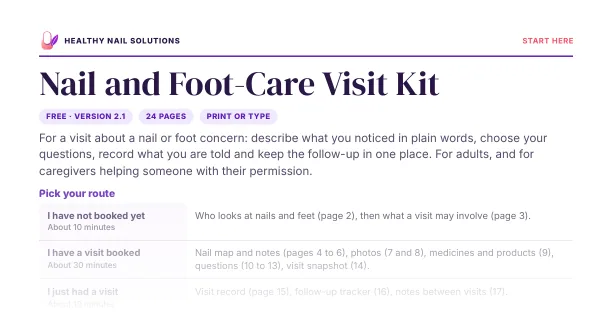
The free Nail and Foot-Care Visit Kit is 24 pages: a nail map, a photo log, a medicines and products list, questions by type of visit, a visit snapshot and record, and notes between visits. PDF in US Letter or A4, and an editable DOCX.
Free: enter your first name and email, reply VERIFY to our short email, and we email you the link. Then 4 short tip emails over 11 days, each with an unsubscribe link.
First, ask what the clinic needs on paper
Before you solve the printing problem, check that there is one. Call the clinic and ask three things:
- Which medical forms, if any, do I need to bring already printed?
- Can anything be completed at the desk, and should I arrive early to do it?
- Do you need my referral card, insurance card or ID as paper, or is a photo on my phone enough?
Answers differ by clinic, so ask rather than guess, and ask before Tuesday if you can. Write the answers on the back of the sheet you are about to fold.
Whatever they say, the forms are not the part of the visit that keeps you up. The conversation is, and that part can be prepared tonight.

Fold one sheet into three panels
Standard copy paper and a pen. No printer, no login, no download.
1. Fold the sheet into three.
Fold it the way a letter goes into an envelope, then press the creases so it lies flat in a bag.
2. Label the panels.
Appointment date and time in a top corner, then Snapshot, Questions and Notes.
3. Fill the snapshot first.
About ten minutes, and it is the part most people skip.
4. Write three questions.
One sentence each, with two blank lines under every question.
5. Leave the three backs empty.
The reverse of each panel is for what you hear in the room. Empty space is the point.
Panel one: the visit snapshot
Five lines in your own words. No medical vocabulary needed.
- When and where: date, time, clinic and who you are seeing.
- Why you are going, in the words you would use with a friend.
- When you first noticed the change, as close to a month as you can get.
- What you have already tried, in date order, including what you stopped and when.
- What the clinic told you to bring or do beforehand.
A change in a nail can have more than one cause, so this panel records what you noticed, not a conclusion about what it is. A qualified health professional is the person who can assess that. What the list does is save you from trying to remember it under pressure.
Panel two: three questions, most important first
Write each question as a sentence you would say out loud. “My nail” is a topic; “what could be causing the change in my nail?” is a question. Put the one you most want answered at the top, because time in the room can be short.
Two more that many people want to ask, as illustrations rather than advice: “What should I watch for before the next visit?” and “What is the next step, and when should I come back?” Write them in your own words. If choosing is the hard part, our guide to three questions to write before a nail-care appointment walks through it.
Then the freeze plan. Under each question, leave two lines: one for the answer, one for a word you did not understand, so you can ask about it before you leave the room. If your mind goes blank, read question one from the sheet. Reading from paper is allowed; that is why the sheet is in your hand.
Panel three: notes in the room
Before you go in, write four headings on the backs: what was said, what was unclear, next step, who to call. Copy the words you were given rather than a tidy summary. Put the question mark where it happened; it is much harder to reconstruct afterwards.
If writing in the room feels awkward, write in the car or on the bus within ten minutes. What fades first is the practical detail: how often, how long, what to do if something changes, who to call. Our guide to appointment notes when there is no desk does the same job with a card instead of a sheet.
The phone-photo filing trick
Photograph the sheet before you leave the house, then again after the visit with the notes on it. Keep both in one phone album named the same way each time, such as the month and the clinic. The paper goes in your folder; the photo is your copy for the day the folder is not with you. It takes about thirty seconds, and it is the difference between a sheet you can find in December and one you cannot.
Check where your camera saves before you photograph. If your phone syncs pictures to a shared family album or a work account, your notes may be visible to other people. Caregivers: ask the person you support before you photograph, copy or share their notes.
Nothing you write on the sheet reaches us. The paper and the photo stay yours.

Fictional example: Monday, 8:40 p.m.
Snapshot: “Tue 10:15, foot clinic. Nail first noticed in spring, thick and yellow since about June. Two shop creams and a soak, stopped in July.”
Questions panel: three questions, the first one circled. Notes panel: four headings, still empty. One photo of the open sheet goes into an album named for the month, and the folded sheet goes into the bag by the door.
Most of the twenty minutes went on deciding which question mattered most. This is record keeping only: not a patient case, not a diagnosis and not a health result.
If a printer turns up before Tuesday
Two settings do most of the work. Match the paper size in the print dialog to the paper in the tray — Letter is 8.5 by 11 inches and A4 is 8.3 by 11.7 inches — and check the preview before you print. A Pages per sheet option prints two or four pages on one sheet if you want to carry more on less paper. No printer at all, and you expect to print visit pages again? A library or print shop is often enough for a few sheets; our guide to printers for planner PDFs covers outside printing first, then what to check before buying one.
If you would rather start from a prepared page, the free Nail and Foot-Care Visit Kit comes as one 24-page PDF in US Letter or A4, an editable DOCX that works offline, or one ZIP with all three. It is free with your email and needs no account.
“I have already spent money on this. Why would a free sheet help?”
It is a fair question, and the honest answer is that the sheet does not treat anything. It will not tell you what is wrong with your nail, it does not replace an assessment by a qualified health professional, and it does not join the drawer of things that promised to end the problem. This page is educational organizing help, not medical advice, and it does not diagnose or recommend a product.
What it changes is smaller and closer to the part you control. If the visit is rushed, the question you were most worried about disappears first. Written down, it survives: your three questions are on a panel you can hold, the answer has a line to land on, and the instructions have somewhere to go. That is organizing, not medicine.
Then the email question. The kit form asks for a first name and an email address, and that is all. You reply VERIFY to our short confirmation email and we send the link to the download page; four short tip emails follow, the series ends, and every email has an unsubscribe link at the bottom. There is no account, no checkout and nothing sold on this site. We do not ask about your nails, a diagnosis or your medicines, and our Privacy Policy explains how to ask us to correct or delete your details.
Before you go to bed
- The sheet is folded and labeled with the appointment date.
- The snapshot has five lines, including what you have already tried.
- Three questions are written, the most important one first.
- There are two blank lines under each question.
- The notes panel has four headings, and the backs are still empty.
- A photo of the sheet sits in one named album on your phone.
- The sheet is in the bag you are taking.
Seven ticks do not make an appointment go well, and no printable replaces a qualified health professional. They do mean you walk in with your main question somewhere you can read it.
Organization tools, not medical advice. This page helps you prepare questions and keep notes. It does not diagnose a nail condition, recommend a treatment or promise a result. For an assessment, speak with a qualified health professional. Educational and medical scope
Questions people ask
Can I prepare for a foot appointment without a printer?
Yes. Fold one sheet of paper into three panels and label them snapshot, questions and notes. That holds the same three jobs as a printed template for one visit, and it fits in a pocket. It is an organizing tool, not medical advice.
What if I cannot print my medical forms?
Ask the clinic which forms you actually need on paper and whether anything can be completed at the desk. Then fold the sheet and write your three questions. That prepares you for the conversation, which is the part the clinic cannot do for you.
Does the free visit kit ask for health details or a login?
No. The form asks for a first name and an email address, and that is all. There is no account and no checkout. You reply VERIFY to our short confirmation email and we send the download link; four short tip emails follow, then the series ends, and every email has an unsubscribe link at the bottom. We do not ask about your nails, a diagnosis or your medicines.
Sources and editorial notes
- Microsoft Support, Print in Microsoft Edge, retrieved October 18, 2026. Its print dialog lists Letter at 8.5 x 11 inches and A4 at 8.3 x 11.7 inches, and a Pages per sheet setting.
Examples are illustrative. Not clinically reviewed. See our Editorial Policy, Review Methodology and Affiliate Disclosure.
Keep going
More on writing the questions down, taking notes and keeping the paper that goes to the visit.
How to Use Your Question Card When There Is No Desk
Plan a writing surface and keep pages together.
Three Questions to Write Before a Nail-Care Appointment
Describe what you noticed, choose three questions, record the answers.
What to Bring to a Nail or Foot-Care Appointment
Ask the office, gather your card and notes, return papers to one place.
Three questions fit on one folded sheet.
Write them tonight, photograph the sheet, and put it in the bag by the door.
Free: enter your first name and email, reply VERIFY to our short email, and we email you the link. Then 4 short tip emails over 11 days, each with an unsubscribe link. Nothing is for sale.