
Appointments & Questions
Doctor visit anxiety: three lines on one small card
When the question comes and your mind goes blank, one small card gives the first thirty seconds somewhere to start.
Educational organizing help. Not medical advice.
“So what’s going on?”
The question is short and it empties your head. You had the whole explanation ready in the car. What comes out is: “My toe looks bad.” Then a pause, and the feeling that you have arrived unprepared.
You are not unprepared. You have a nail that has been on your mind for months and a list of things you have already tried. What you do not have is a short, fixed order to put it in, and an open question in a small room is a hard place to invent one.
This page is about that moment of doctor visit anxiety. It gives you three lines on one small card — an opening line, a when-it-started line and a recovery line for when your mind goes blank — practiced once, out loud, at home.
It is an organizing method, not medical advice. It does not tell you what is wrong with your nail or what to do about it. If a nail looks different to you, have it looked at by a qualified health professional.

Browse 42 question prompts.
The free question prompt bank has 42 prompts in five groups to read and borrow wording from. Choosing your top three and printing them as one page happen in the visit pack builder, part of the free visit kit.
Free to browse. The question page comes with the free kit sign-up and a VERIFY reply.
Three lines on one small card
Three numbered lines, written by hand, on a card small enough for a pocket or a phone case. Not a speech. A place to look.
| Line | What you write | Words that work |
|---|---|---|
| 1. The opening | Permission to use your notes, and the reason you booked. | “I wrote a few things down so I don’t lose my place. May I start with why I booked?” |
| 2. When it started | Roughly when you first noticed, and what is different now. | “This started around last spring. Since then, the nail looks thicker.” |
| 3. The recovery | The line you use when the words stop coming. | “Can I check my notes for a second?” |
Lines to copy or rewrite. This is an organizing aid, not medical advice.
The opening line buys you two seconds, and it makes paper in your hand ordinary before anyone in the room feels awkward about it. The when-it-started line holds the one piece of history you would hate to lose. The recovery line matters most, because blank moments rarely arrive at the start. They come in the middle, on a question you did not expect.
If you would rather start from ready-made prompts, the free Appointment Question Card gives you eight question ideas to tick and room on page 2 for three questions with their answers.
Anxiety before a doctor visit: practice once at home
For many people, the hardest part is the unknown: who will ask what, and in which order. Practice does not remove the nerves. It gives the first line somewhere to go.
1. Write the card by hand.
Three lines, in your own words, on an index card or the back of an envelope. Handwriting makes the words yours.
2. Read it aloud once.
Standing at the kitchen table, not silently. Notice where you stumble; that line needs shorter words.
3. Say it once by the front door.
Wearing your coat, with the card in the pocket it will actually be in. It feels different standing up, and you will be standing up.
4. Put the card where you will not have to look for it.
With your keys, in the appointment folder, behind the phone case. The card only helps if finding it is automatic.
The whole thing takes about five minutes. Say the lines badly at home, so that saying them badly in the room is allowed too. For what to carry on the day, see our appointment paperwork checklist.
A fictional worked exchange
“So what’s going on today?”
“I wrote a few things down so I don’t lose my place. May I read them?”
“Of course.”
“This started around last spring, on my right big toenail. Since then the nail looks thicker, and I have stopped wearing two pairs of shoes because of how it feels. What I would like today is to know what to do day to day while this is being looked at, and when I should come back.”
“Have you tried anything for it?”
“Can I check my notes for a second? Yes — a foot moisturizer over the winter, and a pharmacy product for about a month. I am not using either now.”
Fictional wording for illustration. Not a patient case and not a health result.
Notice that the card was used, not recited, so the answers stayed short. The recovery line came in the middle of the conversation, which is where it usually gets used. And the request came in the first breath, not at the door.
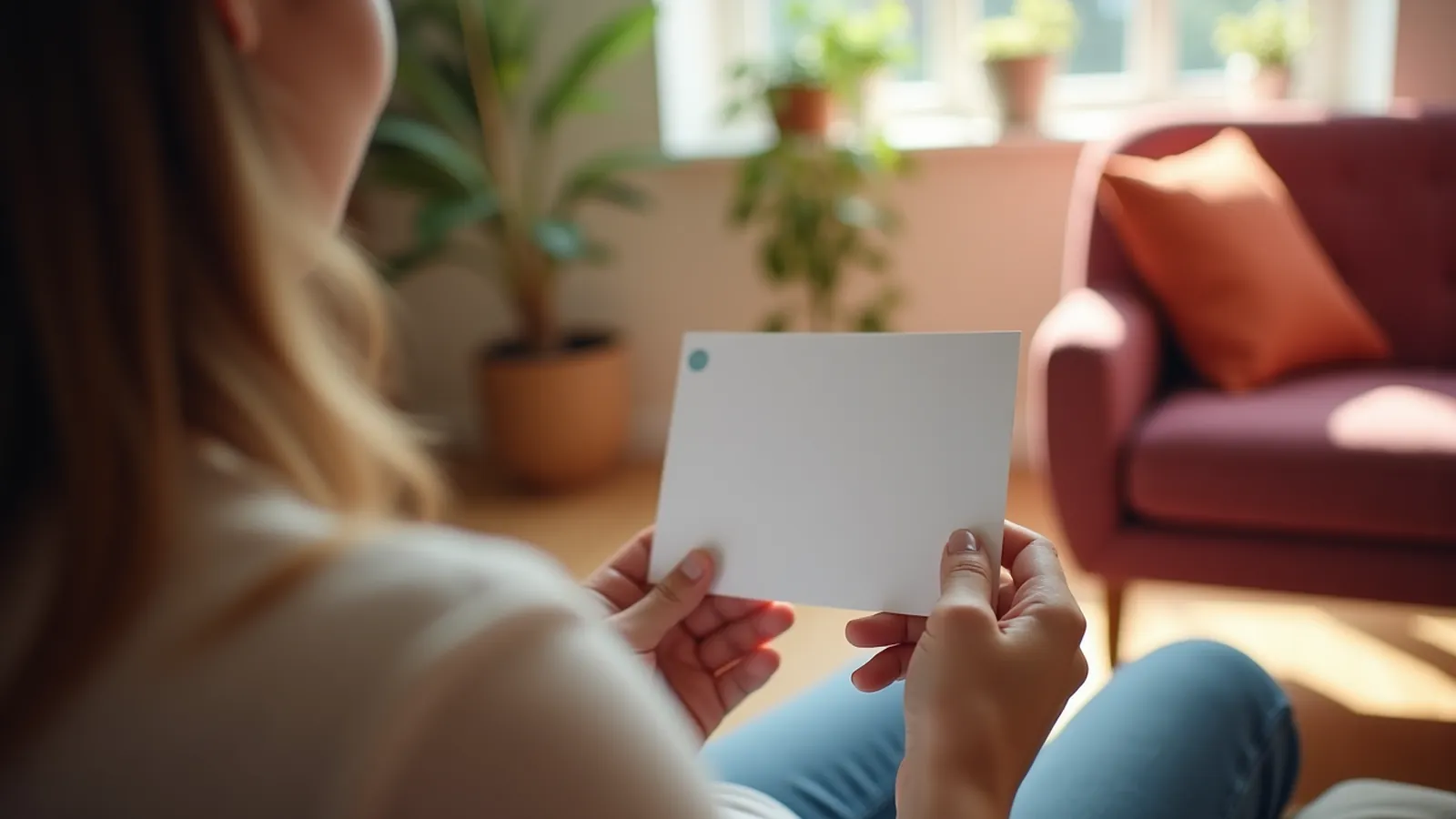
When your mind goes blank at the doctor
It happens to careful people. The fix is not to talk faster or to apologize. It is three small moves.
- Stop mid-sentence. That is allowed, and no one will think less of you for it.
- Look at the card, not at the clock.
- Say the recovery line, then read the next line aloud.
If reading aloud feels like too much, hand the card over. Paper does not get flustered, and a short list is an ordinary thing to be given. If you get through only the opening and your request, that is still a good visit; those two parts steer it.
If you are in the room as a caregiver, ask before you read from notes about someone else, and share only what they have agreed to share.
The worry that you will waste the visit
The fear is specific. The professional glances at the nail, says one word, hands over a prescription, and you are back in the parking lot no wiser than you went in. Or you freeze, the thing that has been worrying you for months stays unsaid, and you are still choosing shoes that hide your feet.
You cannot control how long the visit lasts. You can control three things: what you bring, what you ask first, and what you write down before you leave. So ask your request early rather than at the door, keep the card on your knee instead of folded in a pocket, and write instructions in the professional’s words with a line in your own beside them. Our guide to taking notes when there is no desk covers the shorthand.
One honest note on timelines, from a cited source. The American Academy of Dermatology’s page on nail fungus diagnosis and treatment describes one prescription treatment applied once a day at home, usually for 48 weeks, and one that can mean office visits as often as once a month for trimming. Whatever your own situation turns out to be, that is one reason a written line or two across visits earns its ten minutes. Three questions to write before a nail-care appointment shows how to choose when there is room for only one.
When instructions do come, the free Care Instruction Capture Template has a place for the instruction as given and a place for what you understood, so you can check the two against each other.
Why a free printable would be any different
It might not be, and it is worth saying plainly. If you have already spent money on creams, soaks and gadgets that promised a lot and did not deliver, your guard is up, and it should be. Nothing here treats anything, and we do not sell supplements, soaks or devices.
What the free Nail and Foot-Care Visit Kit offers is one place to keep your visit questions and notes; the three lines on the card are yours to write. It comes as one 24-page PDF in US Letter or A4, an editable DOCX, or one ZIP with all three. It promises nothing.
About the email, since that is the part that makes people wary. Downloads here ask for a first name and an email address, because that is how the file link reaches you, and the form asks for nothing else. You get a short confirmation email with no link; reply VERIFY to it and the delivery email with the link follows. Replying also starts four short tip emails, sent about 2, 4, 7 and 11 days later, and then the series ends. Every email has an unsubscribe link at the bottom. We do not ask for health details and we ask you not to send any. Nothing is sold on this site, there is no checkout, and no account is needed.
If you would rather not give an email, an index card and a pen do the same job. The three lines are the method. The card is only where they live.
Organization tools, not medical advice. This page helps you prepare questions and keep notes. It does not diagnose a nail condition, recommend a treatment or promise a result. For an assessment, speak with a qualified health professional. Educational and medical scope
Questions people ask
Why does my mind go blank at the doctor?
An open question in a small room is a hard place to build an answer, and the opening moments are the part most people never practice. It is not a sign that you are unprepared. A written card gives your answer somewhere to start.
How do I calm anxiety before a doctor visit?
Practice the lines out loud once at home, put the card where you will find it without looking, and decide the one request you want to make before you walk in. The aim is not to feel calm. It is to have something to say while you are not calm.
What should go on a doctor visit cue card?
Three lines: an opening that asks to use your notes, a when-it-started line with what has changed since, and a recovery line such as “Can I check my notes for a second?” Keep it to one card you can hold.
Do I need to give an email to make a cue card?
No. An index card and a pen do the job. An email address is asked for when you download one of our files, because that is how the link reaches you.
Sources and editorial notes
- American Academy of Dermatology, Nail fungus: diagnosis and treatment, retrieved October 18, 2026. It describes one prescription treatment applied once a day at home, usually for 48 weeks, and one that can mean office visits as often as once a month for trimming.
Examples are illustrative. Not clinically reviewed. See our Editorial Policy, Review Methodology and Affiliate Disclosure.
Keep your preparation connected
Back to the blogThree Questions to Write Before a Nail-Care Appointment
Describe what you noticed, choose three questions, record the answers.
How to Use Your Question Card When There Is No Desk
Plan a writing surface and keep pages together.
What to Bring to a Nail or Foot-Care Appointment
Ask the office, gather your card and notes, return papers to one place.
Write the three lines before you need them.
A card in your pocket is easier to find than a sentence in your head.
Free · email to download.