
Printing & formats
Are free health printables safe? A three-question check
You can tell a lot about a free health printable by asking what it says it is, which sources it names, and what it wants from you. Here is the check, run on our own free kit.
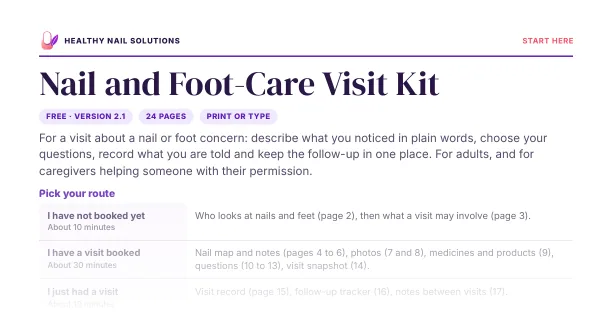
You have seen the pattern before. A page offers to help with a health worry, and by page three it is recommending a supplement or a soak, with a form at the end to collect your email address. So when another free health printable appears, the fair question is not “is it free?” It is “what is this actually selling?”
Below is a three-question check you can run on any health printable in about five minutes, with no medical background. Then the same check is run on the free Nail and Foot-Care Visit Kit, in public, so you can judge the answers yourself. No printable can promise that an appointment will go well. What you can do is walk in with your main question already written down.
Keep your questions and notes in one place.
The free Nail and Foot-Care Visit Kit is 24 pages: a nail map, a photo log, a medicines and products list, questions by type of visit, a visit snapshot and record, and notes between visits. PDF in US Letter or A4, and an editable DOCX.
Free: enter your first name and email, reply VERIFY to our short email, and we email you the link. Then 4 short tip emails over 11 days, each with an unsubscribe link.
The three-question check for free health printables
Plenty of free health printables are plain paper tools; some are sales pages with a worksheet attached. The two can look the same for the first minute, so use something quick to tell them apart.
1. What does it say it is?
Look for a plain statement of the page’s job and its limits: educational, not medical advice, does not diagnose.
2. Which sources does it name?
Organizations you can look up, page titles, links that open, and the date the information was retrieved.
3. What does it want from you?
An email address in exchange for a file is a normal trade. Photos of your nails or a medicine list is not.
None of the three needs medical knowledge. They are the questions you would ask about a free sample on a store counter: what is it, who says so, and what is the catch?

Question one: what does it say it is?
The scope statement is the part a sales page skips. Read the top of the page and ask whether it tells you what the page will not do. Two sentences matter. One should say the material is educational and not a substitute for advice from a qualified health professional. The other should say it does not diagnose a condition, recommend a product or set out a routine.
Our Educational and Medical Scope page is short on purpose: this site helps you prepare questions, record instructions and keep nail- and foot-care paperwork organized. It does not diagnose or treat, and it does not tell you which product, remedy or routine to use. Keep that last sentence as your test. If a page cannot say in plain words what it is for, the plain-language part is missing, and the rest will be harder to check.
Question two: which sources are named?
A named organization is a starting point, not a promise. What makes a citation useful is that you can open it, read the same words and see how old it is.
MedlinePlus, the consumer health site from the National Library of Medicine, suggests a short list of questions for judging health information: how old is it, is the author an expert on the subject, and does it list the sources behind the content. It also advises talking with your provider before using information to make decisions that may affect your health.
Apply the same test to any printable. A source list should give the organization, the page title, a link and the date the page was retrieved. A name that appears only as a logo in a banner cannot be checked. The education pages on this site name organizations such as the American Academy of Dermatology, the American Podiatric Medical Association and the NHS, with a link and a retrieval date where they are used. Our Editorial Policy explains how sources are chosen.
Question three: what does it want from you?
Every free thing is paid for somehow, and the honest ones say how. So the fair answer to “it just wants my email so it can sell me something” is to look at what happens after the email. Your address in exchange for a file is a fair trade, and so is a plainly labeled shop elsewhere on the site. The unfair version is the one you meet at the end, when the printable turns into a product page.
Some things a health printable should never need before it hands over a file: photos of your nails or feet, a description of your symptoms or a diagnosis, a list of your medicines, or payment details for something described as free. If a form asks for any of those, close the tab.
Here is this site’s ask in full: a first name and an email address. You reply VERIFY to our short confirmation email, and then we email you the link to the download page. After that come four short tip emails, about 2, 4, 7 and 11 days later, and then the series ends. Every email has an unsubscribe link at the bottom. There is no account to create, and nothing is sold on this site. The form does not ask about your nails or your health, and we ask people not to send that information. The downloadable files are static: what you type into the DOCX stays on your own device. Our Privacy Policy sets out what the forms collect and how to ask us to correct or delete it.
Run the check on the free kit
Rather than ask you to trust a summary, here are the same three questions applied to our own material, with the place to look for each answer.
| Question | Where to look | What you should find |
|---|---|---|
| Scope | The Educational and Medical Scope page | Organizing help, not medical advice. No diagnosis and no product picks. |
| Sources | The source list at the end of an education page | Organizations such as the AAD, APMA and the NHS, with a link and a retrieval date where they are used. |
| The ask | The kit form and the emails that follow | First name and email, a confirmation email to reply to, the link, four tips, then the series ends. |
| What it will not do | The scope page and this article | No product recommendation and no promise about how a nail will look. |
Our own description of our own free resource, not an independent review. Run the check yourself before you decide.
Scope: organizing help, not medical advice. Sources: three named organizations, all open. Ask: first name and email, no checkout.
Illustrative only. Not a review of a real printable, and not a health result.

Why a printable will not fix a rushed visit
If you have already tried creams or soaks and still have questions, a free PDF will not treat a nail, and it will not make an appointment longer. Nothing on this site claims otherwise, and no printable is medical advice.
What it can do is smaller and closer to the part of the visit you control. MedlinePlus’s advice on talking with your doctor is mostly preparation: write a list of the questions and concerns you want to raise, write a short description of the problem, take notes during the appointment, and ask for written instructions if you need them. None of that is medicine. All of it is organizing, and it is the part that tends to vanish when you are nervous.
Two pages of writing do not promise a better visit. They give your main question a way to survive a rushed ten minutes: you still have to ask it out loud, but you can read it from the page instead of trying to remember it while the clock runs. If preparation is the part you want first, the Appointment Question Card is a free two-page version: eight question ideas to tick, four preparation checks, and space for the answers. The kit also comes as a printable PDF and an editable DOCX that works offline; our guide to paper or an editable DOCX covers which suits a folder.
Signs to walk away from
- A product appears before the topic does. If a supplement or device is named in the first paragraph, the page is an advertisement with an introduction attached.
- Promises about how a nail will look. Before-and-after photos and neat timelines are marketing.
- Health details demanded up front. A free file should not need your diagnosis or a medicine list to unlock.
- Sources that will not open. A name you cannot check, with no title and no date, is a logo.
- A price after the email step. Free should stay free once you have handed over your address.
The five-minute check before you type your email
- The page says what it is for and what it will not do.
- It names at least one organization you can look up.
- At least one source link opens and matches what the page said.
- The form asks for no health details.
- You can see what happens after the download, including how to unsubscribe.
- There is no product to buy at the end of the file.
Six ticks do not turn a printable into medical advice, and no printable replaces a qualified health professional. They do tell you what kind of thing you have downloaded, which is the question you started with.
Organization tools, not medical advice. This page helps you prepare questions and keep notes. It does not diagnose a nail condition, recommend a treatment or promise a result. For an assessment, speak with a qualified health professional. Educational and medical scope
Questions people ask
Are free health printables safe?
They can be, if you check three things first: what the printable says it is, which sources it names, and what it wants from you before it hands over the file. A page that states its limits, cites sources you can open and asks only for an email is doing what a free resource should do. It is still not medical advice.
What are health binder printables used for?
Usually for organizing: appointment questions, notes taken in the room, instruction records, and a page for each visit kept in date order. They are paper tools for tracking paperwork, not treatment plans.
Does the free visit kit ask for health details or try to sell me something?
No. The form asks for a first name and an email address, and that is all. It does not ask about your nails, a diagnosis or your medicines, there is no account and no checkout, and nothing is sold on this site.
Sources and editorial notes
- MedlinePlus, Evaluating Health Information, retrieved October 18, 2026. It suggests asking how old health information is, whether the author is an expert, and whether the sources behind the content are listed, and it advises talking with your provider before using information to make decisions that may affect your health.
- MedlinePlus, Talking With Your Doctor, retrieved October 18, 2026. It suggests writing a list of the questions and concerns you want to raise, writing a short description of the problem, taking notes during the appointment, and asking for written instructions if you need them.
Examples are illustrative. Not clinically reviewed. See our Editorial Policy, Review Methodology and Affiliate Disclosure.
Keep going
More on paper, printing and keeping the pages that go to the visit.
File Access Help
Open, edit, print and save the free files.
Resource Test Record
Dated print, format and keyboard checks of the free resources.
How to Keep Printed Nail-Care Notes Private at Home
A private place, caregiver permissions and existing storage first.
Check the scope, the sources and the ask.
Then decide for yourself whether the free visit kit earns a place in your folder.
Free: enter your first name and email, reply VERIFY to our short email, and we email you the link. Then 4 short tip emails over 11 days, each with an unsubscribe link. Nothing is for sale.